
Global Insurance Market: Strategic Intelligence, Forecasts & Risk Analysis
Global Insurance Market Size: $8.58 Trillion by 2036
GIMSAF (Global Insurance Market Size and Forecast) is the MA-4Consult framework for independent quantitative insurance market sizing and forecasting across 150+ national insurance markets, covering global insurance market size, Life and Non-Life insurance, Total Addressable Market (TAM), Serviceable Available Market (SAM), macro-financial risk and the proprietary Risk Resilience Factor for Insurance (RRF-i).
NEW: Global Insurance Market Sizing and Forecast 2026–2036 (🇬🇧)
Update 2026: The Global Insurance Market Sizing and Forecast 2026–2036 is the current MA-4Consult publication associated with the GIMSAF (Global Insurance Market Size and Forecast) framework. It provides an independent quantitative analysis of global insurance market development across more than 150 national insurance markets. The latest international MA-4Consult Global Insurance Market Sizing and Forecast 2026–2036 projects a global Total Addressable Market (TAM) of $6.90 trillion in 2026, representing 3.8% year-over-year growth, rising to $8.58 trillion by 2036. The resulting nominal global TAM CAGR is approximately 2.2% over the 2026–2036 forecast period.
The current 2026–2036 edition replaces the previous 2025–2035 projection and represents the latest international MA-4Consult market forecast. The analysis covers more than 150 national insurance markets and evaluates Life and Non-Life insurance, TAM and SAM, regional market shifts, and economic, political, institutional and risk-related factors. The international edition is published in English. This page provides a concise summary of the principal findings.
Version auf Deutsch (🇩🇪)

Key Findings – Global Insurance Market 2026–2036
The global insurance market reaches an estimated $6.90 trillion TAM in 2026, up 3.8% from 2025. Growth is expected to normalize to 2.5% in 2027, while the global TAM increases to $8.58 trillion by 2036. The forecast also distinguishes between nominal market expansion and real insurance premium growth. While nominal global TAM growth corresponds to an approximately 2.2% CAGR, the modeled real CAGR is 2.1% for Non-Life and 1.9% for Life.
This distinction is strategically important: Market Size ≠ Market Opportunity.
A larger global insurance market does not automatically translate into an equivalent level of commercially addressable opportunity. Market access, regulation, institutional conditions, economic resilience and country-specific risk can materially affect the market that insurers, reinsurers, brokers and capital providers can realistically address.
What is the Global Insurance Market?
The global insurance market comprises the worldwide economic volume of Life and Non-Life insurance across national insurance markets. The MA-4Consult Global Insurance Market Report measures global insurance market size, market structure and projected development rather than commercial insurance renewal-rate movements. The 2026–2036 model estimates a global insurance market of approximately $6.90 trillion in 2026, increasing to $8.58 trillion by 2036 across 150+ sovereign markets.
In the insurance industry, various proprietary market indices are also used to track changes in commercial insurance pricing and renewal rates. Such pricing indices address a different analytical question from global insurance market sizing and long-term market forecasting. The MA-4Consult Global Insurance Market Report (Global Insurance Market Sizing and Forecast) is an independent market-sizing and forecasting analysis and does not constitute, reproduce or represent any such proprietary pricing index.
How large will the global insurance market be in 2036?
MA-4Consult projects a global insurance TAM of $8.58 trillion by 2036. In 2026, approximately $3.78 trillion (55%) is attributable to Non-Life insurance and $3.12 trillion (45%) to Life insurance. By 2036, the modeled Non-Life TAM reaches $4.72 trillion, while Life reaches $3.86 trillion. The projected 2036 global insurance market structure is:
- Life Insurance: 45%
- Health & Accident: 25%
- Motor: 12%
- Property: 9%
- Liability: 3%
- Marine, Aviation & Transport: 1%
- Specialty / Others: 5%
Non-Life therefore remains the larger global insurance segment, while Life Insurance represents approximately 45% of global TAM in 2036.
Which are the largest insurance markets in 2036?
The global insurance market remains highly concentrated among a relatively small number of major national markets.
The five largest insurance markets by projected 2036 TAM are:
- United States
- China
- United Kingdom
- Germany
- France
Together, these five markets account for approximately 65.7% of global TAM in 2036, while the ten largest markets account for approximately 77.0%. The United States remains by far the world's largest insurance market, with projected 2036 TAM of approximately $3.4 trillion, including $1.2 trillion Life and $2.2 trillion Non-Life. The United States therefore represents approximately 39.8% of global TAM. China ranks second with projected 2036 TAM of approximately $1.1 trillion. Market size alone, however, is insufficient for international market entry or capital allocation decisions.
| Countries (ranked by nominal USD TAM 2036) | ISO | TAM LIFE 2036 projected [bn USD] | TAM non-LIFE 2036 projected [bn USD] | TAM Total 2036 projected [bn USD] | RRF-i (2026) | SAM Total 2036 projected [bn USD] | SAM Total 2036 projected [bn EUR] | USD TAM market share [%] | USD SAM market share [%] |
|---|---|---|---|---|---|---|---|---|---|
| USA | USA | $1 197 | $2 212 | $ 3 410 bn | 1 | $ 3 234 bn | € 2 650 bn | 39.8% | 48.1% |
| China | CHN | $614.6 | $484.6 | $ 1 099 bn | 3 | $ 732.5 bn | € 600.2 bn | 12.8% | 10.9% |
| UK | GBR | $258.1 | $169.4 | $ 427.5 bn | 2 | $ 317.4 bn | € 260.1 bn | 5.0% | 4.7% |
| Germany | DEU | $145.0 | $212.3 | $ 357.2 bn | 3 | $ 253.6 bn | € 207.8 bn | 4.2% | 3.8% |
| France | FRA | $172.2 | $163.7 | $ 335.8 bn | 3 | $ 234.2 bn | € 191.9 bn | 3.9% | 3.5% |
The table ranks the 5 largest insurance markets globally by projected 2036 Total Addressable Market (TAM), combining Life and Non-Life insurance premiums and showing each market’s projected SAM, global market share, and RRF-i risk rating.
What is the difference between TAM and SAM in insurance?
A central element of the MA-4Consult framework is the distinction between Total Addressable Market (TAM) and Serviceable Available Market (SAM). TAM represents the total market volume modeled as addressable. SAM represents the portion that can be considered realistically serviceable under regulatory, institutional, economic and operational conditions. The difference is significant across national insurance markets. For 2036, MA-4Consult models:
- United States: $3.23 trillion SAM, or 94.9% of TAM
- China: $732.5 billion SAM, or 66.6% of TAM
- United Kingdom: 74.2% SAM/TAM
- Germany: 71.0%
- France: 69.7%
- Japan: 65.2%
Several smaller developed insurance markets show particularly high SAM/TAM ratios, including:
- Ireland: 95.7%
- Luxembourg: 89.3%
- Singapore: 88.7%
- Switzerland: 87.0%
The strategic implication is clear: The largest insurance markets are not necessarily the most accessible markets.
For insurers, reinsurers, brokers and institutional capital providers, the combination of TAM, SAM/TAM conversion, market structure and risk resilience can therefore be more informative than market volume alone.
Which regional changes will shape the insurance market through 2036?
The global insurance outlook is also influenced by changing regional economic weight. MA-4Consult modeling indicates that Asia's share of global GDP increases from 32% in 2026 to 36% in 2036. North America's share decreases from 29% to 28%, while Europe's share declines from 26% to 24%. For insurers and reinsurers, these shifts matter because long-term economic development can influence insurable assets, corporate investment, insurance penetration and addressable insurance potential.
The regional outlook includes:
- North America: large insurance market and high institutional resilience
- Europe: major insurance market with a declining share of global GDP
- Asia: rising share of global GDP and increasing long-term insurance relevance
- Latin America: growth potential alongside higher macroeconomic and market-access risks
- Middle East: increasing strategic importance alongside elevated geopolitical and inflationary risks
Why are Life and Non-Life insurance markets strategically different?
Leading insurance markets have materially different Life and Non-Life market profiles. In the United States, projected 2036 Non-Life TAM reaches $2.21 trillion, compared with $1.20 trillion Life. China has a more Life-oriented profile, with $614.6 billion Life TAM versus $484.6 billion Non-Life. Japan is also strongly Life-oriented, with $215.2 billion Life TAM compared with $108.6 billion Non-Life. By contrast, Germany, Canada and Australia are more strongly Non-Life-oriented:
- Germany: $145.0B Life / $212.3B Non-Life
- Canada: $55.6B Life / $135.2B Non-Life
- Australia: $32.6B Life / $74.4B Non-Life
These structural differences are relevant to product strategy, distribution, claims infrastructure, capital requirements, underwriting and market-entry models. Life-oriented markets can offer particular relevance for retirement, protection, pensions and long-term financial solutions, while Non-Life-oriented markets can provide larger opportunities across commercial lines, property, casualty, specialty, health and risk-transfer solutions.
Methodology and Analytical Scope
For reinsurance stakeholders, Chief Underwriting Officers, Chief Risk Officers, and institutional investors across the US, UK, and global markets, navigating this $8.6 Trillion horizon requires moving past legacy "rearview mirror" analytics and forward-looking methodologies . Intelligence published under the MA-4Consult brand delivers an independent, quantitative roadmap to master the global polycrisis — providing decision-grade foresight across sovereign risk trajectories (RRF-i index), cyber single points of failure (SPOF), and the operational integration of Agentic AI in autonomous underwriting.
The Risk Resilience Factor for Insurance (RRF-i) is a proprietary MA-4Consult risk and resilience framework for comparing the structural resilience of international insurance markets. For 2026, the model establishes a global RRF-i baseline of 60.5%.
The framework combines:
- 60% macroeconomic factors, including inflation, GDP development and fiscal pressures
- 40% political and institutional risk factors
The analysis additionally considers macroeconomic volatility, geopolitical risks, cyber risks, IT supply-chain risks, natural catastrophes and other systemic loss exposures. RRF-i is intended to complement conventional market-size metrics such as TAM and premium volume with a risk and resilience perspective for international market selection, capital allocation, underwriting, risk management and strategic expansion. RRF-i is a proprietary MA-4Consult model and is not an official regulatory or industry-wide index.
Executive Press Clipping & Market Intelligence
Explore the
Executive Press Clipping Map for the key findings from the Global Insurance Market Sizing and Forecast 2026–2036, including global insurance market growth, market opportunity, risk, resilience and strategic implications across 150+ national insurance markets.
View the Executive Press Clipping Map →
DOWNLOAD
FAQ – Global Insurance Market and Industry Insights
The MA-4Consult FAQ section delivers strategic market intelligence across four core operational pillars:
- Global Insurance Market Forecast & Sizing: Details Total Addressable Market (TAM) expansion, Serviceable Available Market (SAM) metrics, and decadal growth trajectories across sovereign jurisdictions and primary underwriting lines.
- Risk Modeling & Methodology: Outlines our proprietary quantitative modeling engine, sovereign resilience stress-testing, and independent data triangulation frameworks.
- Geopolitical Shocks & Emerging Risks: Evaluates systemic vulnerabilities, macro-financial stability, geopolitical FX settlement shifts, cyber accumulation risks, and the operational integration of Agentic AI in underwriting.
- Publication & Distribution Architecture: Provides details on our global distribution network, secure platform access via Amazon and Google Play, and uncompromised client privacy protocols.
Independent Access to Global Strategic Intelligence
To ensure the highest standards of data security and seamless global logistics, all MA-4Consult professional publications and market reports are distributed exclusively via Amazon and Google Ebooks. As an independent intelligence platform with a global reach, we prioritize your ability to access our proprietary analysis through neutral, world-class marketplaces. This strategic choice provides you with several key advantages:
- Maximum Security & Privacy: Benefit from transparent transactions and industry-leading data protection protocols provided by the world’s most trusted platforms.
- Instant Global Availability: Enjoy rapid delivery via Amazon Prime for print editions or immediate digital access through Kindle and Google Play.
- True Industry Neutrality: By utilizing independent distribution channels, you maintain full discretion. Our insights remain untainted by industry-specific provider interests, ensuring an independent perspective.
Gain immediate access to our Global Insurance Market strategic modeling and navigate the future of risk with confidence.
The Statistical Standard: Global Insurance Market Sizing and Forecast 2026–2036

NAVIGATING POLYCRISIS: Unlocking the $8.6 Trillion Global Insurance Market (2026–2036)
Don’t steer your enterprise with a rearview mirror — navigate systemic risk with decision-grade quantitative foresight. Powered by a proprietary macro-financial model, this strategic intelligence benchmark delivers immediate near-term market momentum for 2026 ($6.90T TAM / 3.8% YoY) alongside 10-year projections scaling to $8.58 Trillion by 2036 across 150+ sovereign jurisdictions.
Inside this Strategic Intelligence Report:
- TAM & SAM Quantification: Comprehensive sizing mapping the expansion from $6.90T in 2026 to $8.58T by 2036, backed by actionable Serviceable Available Market (SAM) benchmarks for Life ($3.0T) and Non-Life ($3.8T).
- Segment-Level Deep Dives: Decadal growth projections across Life (45%), Health & Accident (25%), Motor (12%), Property (9%), Liability (3%), and Marine, Aviation & Transport (1%).
- Proprietary Risk Resilience Index (RRF-i): Sovereign state stress-testing combining 60% macroeconomic parameters (inflation volatility, fiscal stress) with 40% political and institutional risk factors.
- Systemic Shock Modeling: Executive analysis covering USD structural dependencies, sovereign debt shocks, cyber single points of failure (SPOF), and Agentic AI deployment in autonomous underwriting.
ISBN (Paperback Edition): 979-8194887309
Google Play ID (eBook Edition): GGKEY:RCL5JKX8WPA
Global Insurance Market Intelligence 2026: Download the Comprehensive RRF-i Country Risk Report

How does the Risk Resilience Factor for Insurance (RRF-i) evaluate geopolitical and macroeconomic underwriting risks for 2026?
Navigate the volatile intersections of geopolitical fragmentation, inflationary loss cost trends, and macroeconomic protectionism with the official 2026
Global Insurance Country Risk Report. Developed by MA-4Consult in Vienna, Austria, this data-backed study leverages our proprietary
Risk Resilience Factor for Insurance (RRF-i)
framework to quantify structural stability and underwriting vulnerabilities across multiple sovereign jurisdictions worldwide.
Tailored specifically for chief risk officers, commercial insurance executives, and international underwriting teams, this premium diagnostic blueprint evaluates systemic pressures using a disciplined, weighted integration of macroeconomic variables (60% weight) and political risk drivers (40% weight). The comprehensive 2026 risk matrix delivers predictive clarity on capital allocation, hard market dynamics, alternative risk transfer (ART) mechanisms such as parametric structures, and cyber vulnerability accumulations.
Download the full PDF report to optimize your strategic portfolio resilience, secure constrained reinsurance capacity, and adapt your underwriting elasticity to multi-polar macro-regional architectures.
Mastering Geopolitical Risk and Resilience in the Insurance Value Chain

Book: Global Insurance Industry in Transition - Future Trends, Risks, and Opportunities 2035 (ISBN: 979-8290020198)
Understand the structural forces redefining risk management through 2035. This strategic guide analyzes historical turning points — such as 9/11 and the 2008 Financial Crisis — to establish blueprints for future resilience.
It equips business journalists and risk professionals with actionable insights on:
- Geopolitical Risk Management: Navigating the shift from a globalized to a regionalized market model across North America, Europe, and the BRICS+.
- The Cyber Insurance Forecast: Bridging the massive protection gap where $10 trillion in annual economic damage is met by only $15 billion in premiums.
- Climate Risk Adaptation: Transitioning to proactive, data-centric models and Parametric Insurance solutions to mitigate record-level CAT losses.
Strategic Intelligence: Global Insurance Industry in Transition

Archived White Paper: How can insurance leaders master the global insurance market forecast? (free download)
Stay ahead of the curve in a marketplace defined by geoeconomic fragmentation and rapid technological shifts. Download our white paper, "Global Insurance Industry in Transition" an essential guide for insurance executives, reinsurance stakeholders, and business journalists. This report synthesizes a deep-dive analysis of foundational market signals with cutting-edge Open-Source Intelligence (OSINT) to provide a proactive roadmap for the next decade.
Explore the latest Insurance Industry Trends, uncover actionable Insurance Sector Opportunities, and gain a strategic advantage by mastering:
- The Transition to Agentic AI: Moving beyond basic automation to autonomous underwriting and real-time risk scoring.
- Climate Risk Resilience: Adapting to an environment where natural catastrophes consistently exceed $100 billion in insured losses annually.
- The Cyber Protection Gap: Bridging the divide in a landscape where global cybercrime is estimated to inflict $10 trillion in economic damage.
Geopolitical Shockwaves & the Global Insurance Industry
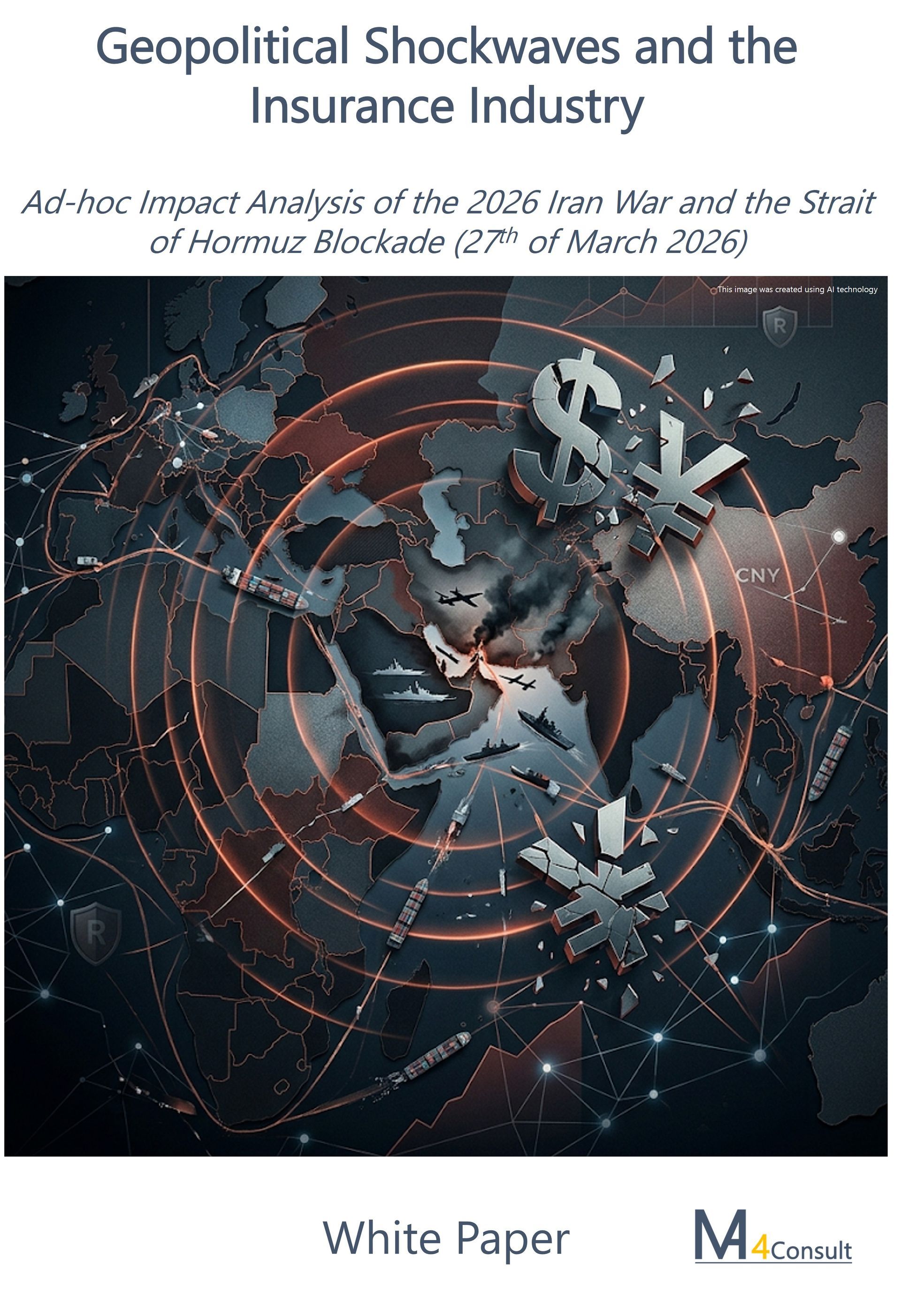
Actionable strategic analysis for insurers confronting the post‑2026 polycrisis. (free download)
The 2026 Iran War and the Strait of Hormuz blockade have disrupted historical risk patterns, creating a new reality for insurers worldwide. As the global insurance market approaches $8.6 trillion, traditional actuarial models are giving way to a complex, multi-layered “Polycrisis” that spans energy, trade, and currency volatility. Our ad-hoc impact analysis delivers a strategic roadmap for navigating a fragmented, multi-polar insurance landscape across North America, Europe, Asia, and the Middle East.
Key Insights for Global Insurance Leaders
- The Petroyuan Shift: Understand how “Operation Epic Fury” is reshaping the dominance of the U.S. dollar in insurance premium settlements and global capital flows.
- Three Strategic Scenarios: Explore detailed modeling of Kinetic Reset (45%), Asymmetric Attrition (30%), and Structural Realignment (25%) to anticipate market volatility.
- RRF-i Metrics: Leverage our proprietary Risk Resilience Factor to rank global insurance market stability from New York to Dubai, London to Shanghai.
- Strategic Bottom Line: Learn why insurers must pivot from chasing total market volume (TAM) to securing market access (SAM) and protecting currency integrity (FX).
Why This Matters
In today’s hyper-connected insurance ecosystem, geopolitical shocks in the Middle East reverberate across Asia, Europe, and the Americas. Insurers who anticipate these risks can optimize capital allocation, safeguard premiums, and maintain strategic market presence across critical regions.
Previous edition of the MA-4Consult Global Insurance Market Report (2025 - 2035)

Archived 2025 Edition – Superseded by the 2026–2036 Report
Don’t steer your business with a rearview mirror — use a strategic compass. This premium 180+ page Global Insurance Market Report is your definitive statistical resource for understanding the international insurance value chain. Covering 150+ countries across life and non-life segments, it delivers data-driven forecasts through 2035, backed by proven methodologies and rigorous trend analysis.
Inside this Strategic Tool, you will find:
- Total Addressable Market (TAM) Analysis: Granular market sizing and growth projections showing why the Top 5 nations will control 63% of the world's premiums.
- Serviceable Available Market (SAM) Frameworks: Identify emerging opportunities in the Global South and BRICS+ nations.
- Macroeconomic Projections: Global outlooks on inflation, interest rate volatility, and GDP trajectories shaping industry dynamics.
- Exclusive Data Dashboards: Country-level insights designed for high-stakes capital allocation and the annual renewal process.
For current global insurance market data, forecasts, TAM/SAM analysis and RRF-i risk assessment, refer to the latest MA-4Consult Global Insurance Market Report 2026–2036.
Europe’s Insurance Future: Actionable Intelligence & 10-Year Forecasts

Why is the Risk Resilience Factor (RRF-i) vital for European capital allocation through 2035? (ISBN: 979-8297783973)
Navigate Europe’s insurance future with precise market intelligence. This premium European Insurance Market Report delivers in-depth analysis and country-level risk assessments for over 50 European markets. Tailored for investors and risk professionals, it uncovers growth opportunities and potential vulnerabilities in the life and non-life sectors, aligned with DORA-compliance and the EU AI Act standards.
What You’ll Discover:
- The Risk Resilience Factor (RRF-i): Our proprietary index quantifying market vulnerabilities to geopolitical shocks and inflationary pressures.
- 10-Year Premium Forecasts: Detailed projections provided in EUR and USD to eliminate FX-related misinterpretations in market comparisons.
- Macroeconomic & Demographic Shifts: Expert analysis of GDP trajectories and aging populations impacting European life insurance relevance.
- Strategic Roadmaps: Targeted recommendations for product innovation, Parametric Insurance adoption, and cross-border volatility management.
MA-4Consult Methodology: Forward-Looking Market Models
The MA-4Consult Market Model provides a multi-dimensional, quantitative framework for projecting 10-year global insurance trajectories across life and non-life segments.In today’s landscape, strategic planning requires forward-looking insights over retrospective data. While historical figures provide context, they are reactive. Our methodology prioritizes future market projections and scenario analysis (Upside/Downside), empowering you to anticipate changes and maintain a competitive edge in a decade defined by the Polycrisis.

Data Triangulation & Source Hierarchy
The modeling engine synthesizes quantitative macroeconomic metrics with qualitative risk signals through a structured, three-tiered data fusion architecture:
- Foundational Layer: Ingests primary macro-financial data—including total GDP, real GDP growth, and GDP per capita—alongside local currency units (LCU) and monetary exchange rate series.
- Verification & Ingestion Layer: Integrates multi-source Open Source Intelligence (OSINT) data, industry reports, and socio-demographic indicators (population, educational attainment, life expectancy).
- Expert Overlay & Calibration: Applies structured expert validation and qualitative risk matrices to weight institutional, geopolitical, and demographic variables against core quantitative outputs.
Country Coverage & Regional Scope
- Jurisdictional Scope: Forecasts total market volumes, premium density, and growth trajectories across 150+ countries, territories, and jurisdictions.
- Regional Clustering: Groups country-level data across key regional economic blocks: Asia-Pacific (APAC), Americas (North, Central, South), Europe (Western, Northern, Southern, Eastern), and Middle East & Africa (MEA).
- Core Sovereign Focus: Conducts deep-dive benchmarking for top global economies controlling over 75% of global GDP to isolate major shifts in international capital deployment.
Currency Conversion & Monetary Processing
- Dual-Currency Presentation: All market figures are simultaneously expressed in EUR and USD, eliminating cross-border conversion friction and facilitating direct regional comparisons.
- Dynamic Recalculation: Uses an integrated FX recalculation mechanism to normalize local currency units (LCU), neutralizing localized monetary distortion and capturing exchange rate volatility relative to anchor currencies.
Core Modeling Variables & Input Parameters
Projections balance three distinct categories of quantitative and qualitative variables:
- Macroeconomic Drivers: Aggregate GDP Total, Real GDP Growth, and GDP per Capita (acting as a proxy for individual risk-bearing capacity and purchasing power).
- Demographic & Social Factors: Population growth, urbanization density, human development/education indices (reflecting risk literacy), and life expectancy (actuarial profiling).
- Institutional & Geopolitical Risks: Risk Resilience Factor (RRF-i), Control of Corruption, Rule of Law, Regulatory Stability, and Security/War threats.
Scenario Modeling & Forecasting Horizons
Projections span a 10-year forward horizon across three explicit macroeconomic modeling trajectories:
- Most Likely (Base) Scenario: Reflected by baseline economic output, steady demographic trends, and standard inflation expectations.
- Downside Scenario: Captures economic contraction, heightened trade protectionism, stagflationary pressures, and elevated geopolitical friction.
- Upside Scenario: Models accelerated industrial expansion, regulatory stability, and heightened capital accumulation.
Methodological Scope & Limitations
- Customer-Centric Sizing: Measures premium volume attributable to insured risks or policyholders within a specific jurisdiction (demand-side focus), distinguishing it from carrier-level Gross Written Premiums (GWP) that incorporate cross-border reinsurance assumptions.
- Market Opportunity Parameters: Differentiates between raw Gross Written Premiums (baseline), Total Addressable Market (TAM: 100% theoretical penetration ceiling), and Serviceable Available Market (SAM: risk-adjusted, practical market opportunity).
- Non-Life Market Definition: Uses 'non-life' as an international market classification encompassing property, casualty, and health-related lines, which differs from standard U.S. P&C definitions.
- Exclusion of Composite Category: Intentionally excludes the "composite" insurer classification to eliminate double-counting, avoid analytical redundancy, and bypass conflicting international regulatory definitions.
Inflation Calibration & Revision Policy
- Real vs. Nominal Adjustments: Primary nominal outputs are filtered through a localized Inflation Outlook parameter, stripping out pricing surges to produce Real Total Market Volume projections that isolate organic market expansion.
- Continuous Calibration: Ongoing ingestion of OSINT reports, macroeconomic shifts, and monetary policy adjustments triggers real-time model re-indexing to ensure strategic alignment with observed global economic realities.
Disclaimer
The books presented on this website are for informational and promotional purposes only. It is important to note that these are personal views and assessments of the insurance market. Please note that this information does not constitute binding advice. We would like to make it clear that no responsibility or liability is assumed for the accuracy, completeness, or timeliness of the content of this website or the books. Please be aware that you use this information at your own risk. If you would like to purchase the books, you will be redirected to Amazon. Please be advised that Amazon's terms and conditions and privacy policy are applicable to the use of its services. We accept no responsibility for the processing of the purchase or any problems that may arise in the process.