
MA-4Consult Knowledge Hub: Strategic Foresight & Global Management Insights

Medien- & Pressebeiträge: Vertriebszeitung: Vertriebsprozesse ohne Ballast
Global Insurance Market 2026–2036: Executive Press Clipping & Market Intelligence

Global Insurance Market to Reach $8.6 Trillion by 2036 — but Market Size Alone Will Not Define Strategic Opportunity
The global insurance market is projected to expand from $6.9 trillion in 2026 to $8.6 trillion by 2036, but market growth alone does not define strategic opportunity. Across more than 150 sovereign markets, differences in segment dynamics, accessibility, macroeconomic conditions, political and institutional resilience, emerging risks and capital requirements will increasingly determine where sustainable insurance growth can be captured.
Source: Global Insurance Market Report 2026–2036 — proprietary market sizing, data triangulation and risk-intelligence analysis.
Explore the latest executive press coverage and strategic insights on the
Global Insurance Market 2026–2036. This executive press clipping map summarizes key findings on global insurance and reinsurance market growth, emerging risks, capital and underwriting capacity, TAM and SAM, market accessibility, risk resilience, and strategic opportunities across
150+ global markets.
The press map provides a concise view of the forces shaping the insurance industry through 2036 — from macroeconomic and geopolitical developments to climate risk, cyber exposure, AI-driven risks and changing market opportunities.
Download the Executive Press Clipping & Strategic Market Intelligence Map
to access the complete visual summary and key market findings.
Analysen & Publikationen: Beschaffung, Führung & Versicherungswirtschaft (Deutsch 🇩🇪)
Baden-Baden Reinsurance Meeting 2026 im Zeichen des Wachstums: Globaler Versicherungsmarkt erreicht 8,58 Billionen Dollar
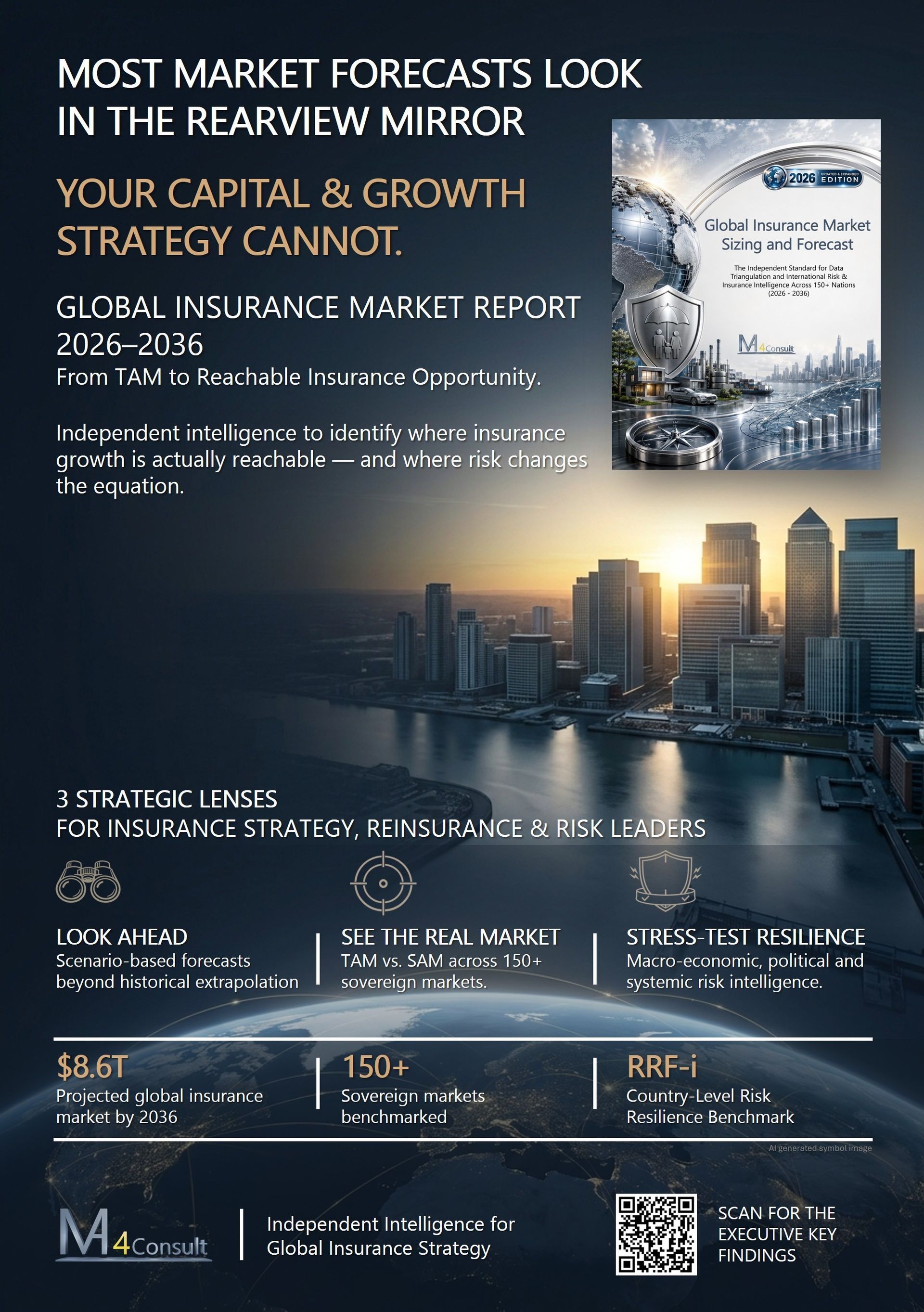
PRESSEMITTEILUNG
MA-4Consult legt zum internationalen Rückversicherungstreffen eine Analyse von mehr als 150 Märkten vor: 8,58 Billionen US-Dollar globales Versicherungsvolumen bis 2036, deutliche Unterschiede bei Marktzugang, adressierbarem Volumen und Risikoresilienz.
Wien, September 2026
Wenn sich die internationale Rückversicherungsbranche im Oktober 2026 in Baden-Baden trifft, geht es nicht nur um Preise, Kapazitäten und Erneuerungen. Für Versicherer, Rückversicherer und Kapitalgeber stellt sich eine grundlegendere Frage: In welchen Märkten ist Wachstum tatsächlich erreichbar – und wo täuscht die Größe des Prämienvolumens über die wirtschaftliche Opportunität hinweg?
Eine aktuelle Analyse unter der Marke MA-4Consult beziffert den globalen Versicherungsmarkt auf 6,9 Billionen US-Dollar für 2026 und prognostiziert einen Anstieg auf ca. 8,6 Billionen US-Dollar bis 2036. Das entspricht einem langfristigen durchschnittlichen Wachstum von 2,1 % pro Jahr. Für 2027 wird eine Wachstumsrate von 2,5 % erwartet.
Doch die zentrale Aussage der Analyse liegt nicht allein in der Größe des globalen Marktes.
„The market is not the same as the opportunity.“
Der von MA-4Consult verwendete Ansatz trennt deshalb zwischen dem Total Addressable Market (TAM) und dem tatsächlich adressierbaren Markt (SAM). Die Analyse weist für 2036 ein aggregiertes TAM-SAM-Verhältnis von 78 % aus. Die aktuellen Daten veröffentlicht auf der MA-4Consult-Website differenzieren diese Betrachtung nach den beiden großen Versicherungskategorien: Life mit 3,0 Billionen US-Dollar beziehungsweise 76 % des Life-TAM und Non-Life mit 3,8 Billionen US-Dollar beziehungsweise 81 % des Non-Life-TAM.
Damit entsteht für die Berichterstattung über Baden-Baden ein zusätzlicher Blickwinkel: Nicht die Größe eines Marktes allein entscheidet über seine strategische Bedeutung.
Die Zahlen hinter dem globalen Versicherungsmarkt
Für 2026 modelliert MA-4Consult einen globalen Versicherungs-TAM von 6,90 Billionen US-Dollar.
Davon entfallen:
- 3,78 Billionen US-Dollar auf Non-Life
- 3,12 Billionen US-Dollar auf Life
Bis 2036 steigt das modellierte Volumen auf 8,58 Billionen US-Dollar:
- 4,72 Billionen US-Dollar Non-Life
- 3,86 Billionen US-Dollar Life
Die Größenordnung macht deutlich, warum globale Marktprognosen für strategische Entscheidungen relevant sind. Gleichzeitig zeigt die weitere Segmentierung, dass sich dieses Wachstum nicht gleichmäßig über Produkte und Länder verteilt.
Der globale Versicherungsmarkt 2036 nach Segmenten
Segment Anteil Volumen 2036
- Life Insurance 45 % 3,86 Bio. USD
- Health & Accident 25 % 2,15 Bio. USD
- Motor 12 % 1,03 Bio. USD
- Property 9 % 0,77 Bio. USD
- Liability 3 % 0,26 Bio. USD
- Marine, Aviation & Transport 1 % 0,09 Bio. USD
- Specialty / Others 5 % 0,43 Bio. USD
Die fünf größten Märkte nach dem für 2036 modellierten TAM sind die USA, China, Großbritannien, Deutschland und Frankreich.
Damit lässt sich eine zweite journalistisch relevante Frage stellen: Wo entsteht das Wachstum – und wo ist es unter realen Marktbedingungen tatsächlich adressierbar?
8,58 Billionen Dollar bedeuten nicht 8,58 Billionen Dollar erreichbares Geschäft
Der Unterschied zwischen TAM und SAM ist für die Analyse zentral. TAM beschreibt den gesamten adressierbaren Markt im jeweiligen Modell. SAM grenzt den Teil des Marktes ab, der unter den jeweiligen Markt- und Risikobedingungen tatsächlich adressierbar ist. Damit wird ein Punkt sichtbar, der bei globalen Marktprognosen leicht verloren geht: Ein großes Prämienvolumen ist nicht automatisch gleichbedeutend mit einem gleich großen strategischen Expansions- oder Underwriting-Potenzial.
Marktzugang, regulatorische Rahmenbedingungen sowie makroökonomische, politische und institutionelle Risiken können die wirtschaftliche Attraktivität einzelner Märkte beeinflussen.
Der Report unter der Marke von MA-4Consult stellt deshalb nicht nur Marktgröße, sondern Marktgröße, Marktadressierbarkeit und Resilienz gegenüber.
Mehr als 150 Märkte statt eines globalen Durchschnitts
Die Analyse umfasst mehr als 150 souveräne Märkte.
Diese Granularität ist für die Interpretation des globalen Wachstums entscheidend. Ein globaler Durchschnitt kann verdecken, dass zwei Märkte mit vergleichbarem Prämienvolumen völlig unterschiedliche Rahmenbedingungen für Versicherer und Rückversicherer aufweisen. Ein großer TAM kann auf einen wesentlich anders strukturierten SAM treffen als in einem anderen Land. Umgekehrt kann ein kleinerer Markt strategisch interessant sein, wenn Marktzugang, Wachstum und Risikoresilienz eine günstige Kombination ergeben.
Globales Marktwachstum ist daher nicht automatisch gleichmäßig verteilbares Wachstum.
RRF-i: Eine zusätzliche Risikodimension für internationale Märkte
Neben TAM und SAM verwenden die Marktreporte unter der Brand MA-4Consult den proprietären Risk Resilience Factor for Insurance (RRF-i). Der Index dient der quantitativen Bewertung der Resilienz von Versicherungsmärkten gegenüber makroökonomischen sowie politischen und institutionellen Risiken. Die methodische Gewichtung besteht aus:
- 60 % makroökonomischen Faktoren, darunter Inflation, BIP-Entwicklung und fiskalische Belastungen;
- 40 % politischen und institutionellen Faktoren.
Für 2026 weist der Report einen globalen RRF-i-Baseline-Wert von 60,5 % aus.
Diese beiden Zahlen dürfen nicht verwechselt werden: 60/40 beschreibt die Gewichtung innerhalb des Modells; 60,5 % ist der ausgewiesene globale Baseline-Wert für 2026. Der RRF-i ist dabei ausdrücklich kein allgemein anerkannter Branchenstandard, sondern ein proprietärer Index der Marke MA-4Consult.
Was bedeutet das für die Gespräche in Baden-Baden?
Das Baden-Baden Reinsurance Meeting 2026 findet im Oktober statt – zu einem Zeitpunkt, an dem die internationale Versicherungs- und Rückversicherungsbranche traditionell auf die kommenden Erneuerungen und die Entwicklung von Risiken, Preisen und Kapazitäten blickt. Genau hier setzt die Analyse an.
Für Rückversicherer stellt sich die Frage, wo Kapital und Kapazität angesichts von Wachstum und veränderten Risikoannahmen eingesetzt werden können.
Für Erstversicherer geht es um die Frage, welche internationalen Märkte und Segmente tatsächlich Wachstumspotenzial bieten.
Für Makler und Berater ist relevant, wie sich Marktgröße, Zugänglichkeit und Risiko in einzelnen Jurisdiktionen unterscheiden.
Und für Kapitalgeber stellt sich die übergeordnete Frage, ob nominelles Marktwachstum tatsächlich in investierbare beziehungsweise adressierbare Opportunitäten übersetzt werden kann.
Gerade bei Risiken mit internationaler Wirkung – etwa Naturkatastrophen, zunehmenden digitalen Abhängigkeiten und technologischen Veränderungen – reicht eine Betrachtung des reinen Prämienvolumens zunehmend weniger aus.
Baden-Baden als Datenpunkt für die Versicherungsbranche
Die Analyse der Brand von MA-4Consult soll dabei nicht vorwegnehmen, welche Themen oder Entscheidungen in Baden-Baden 2026 tatsächlich diskutiert werden.
Sie liefert vielmehr einen quantitativen Hintergrund für eine Frage, die für die Erneuerungs- und Strategiegespräche relevant ist: Wie groß ist der Markt – und welcher Teil davon ist unter realen wirtschaftlichen, regulatorischen und risikobezogenen Bedingungen tatsächlich erreichbar?
Für Journalisten bietet die Kombination aus Event und Marktdaten damit einen konkreten Ansatz für die Berichterstattung über Baden-Baden: Das Treffen der internationalen Rückversicherungsbranche lässt sich mit aktuellen Zahlen zur Größe, Struktur und Risikodifferenzierung des globalen Versicherungsmarktes einordnen.
ÜBER DEN REPORT
- Titel: Global Insurance Market Report 2026–2036 (ISBN-13: 979-8194887309)
- Positionierung: Independent Standard for Data Triangulation and International Risk & Insurance Intelligence Across 150+ Nations
- Zeitraum: 2026–2036
- Abdeckung: 150+ souveräne Märkte
- Schwerpunkte: Global Market Sizing, TAM/SAM, Life & Non-Life, Länderanalysen, Makroökonomie, politische und institutionelle Risiken, RRF-i und strategische Marktchancen.
Der Report ist als Printausgabe über Amazon und als digitale Ausgabe über Google Play Books erhältlich:
- Amazon: https://www.amazon.com/dp/B0HH776T2F
- Google Play Books: https://play.google.com/store/books/details?id=yFMHEgAAQBAJ
ÜBER MA-4CONSULT
MA-4Consult ist ein unabhängiger Knowledge Hub für B2B- und B2G-Entscheider. MA-4Consult verbindet praktische Vertriebs- und Führungserfahrung mit Fachpublikationen, strategischen Frameworks, Beschaffungs- und Vergabethemen sowie globaler Versicherungsmarktanalyse. Unter der Marke MA-4Consult werden quantitative Versicherungsmarkt- und Risikoanalysen angeboten. Die Analysen und Reporte analysieren internationale Versicherungsmärkte auf Länder- und Segmentebene und verbinden Marktgrößen mit makroökonomischen, politischen und institutionellen Risikofaktoren. Der methodische Ansatz basiert auf einer proprietären quantitativen Daten-Engine und Multi-Source-Datentriangulation. Dabei werden unter anderem Bottom-up-Marktdaten, Prämieninformationen und Top-down-makroökonomische Parameter kombiniert.
Bestbieterprinzip: Strategien für B2G-Vertrieb und industrielle Souveränität im DACH-Raum

Das beste Angebot erhält den Zuschlag im Vergabeverfahren! – Ein Fachbuch der Marke MA-4Consult
Wien, Februar 2026 – Der öffentliche Sektor im gesamten DACH-Raum steht heute unter einem gewaltigen Transformations- und Effizienzdruck. In Österreich zwingt die aktuelle Staatsverschuldung von über 85 % des BIP zu extremer Budgetdisziplin. Deutschland modernisiert über milliardenschwere Sondervermögen seine Infrastruktur, während in der Schweiz das revidierte Beschaffungsrecht (BöB/IVöB) den Fokus konsequent auf Qualität und Innovation lenkt.
Inmitten dieser globalen Dynamik hat sich unter der Fachmarke MA-4Consult das Standardwerk „Bestbieterverfahren“ als unverzichtbarer Leitfaden etabliert. Es zeigt auf, wie das Bestbieterprinzip nicht nur die Effizienz steigert, sondern als strategisches Instrument zur Stärkung der regionalen und europäischen Industrie gegenüber Billigkonkurrenz aus Nicht-EU-Staaten dient.
Strategische Exzellenz: Industrielle Souveränität durch intelligente Vergabe
Das Werk bricht mit dem Mythos, dass der niedrigste Preis die beste Lösung sei. Ein zentraler Schwerpunkt der Publikation ist die Erkenntnis, dass ein klug angewandtes Bestbieterprinzip ein entscheidender Hebel für fairen Wettbewerb und die Sicherung europäischer Standards ist.
- Schutz der heimischen Wertschöpfung: Das Buch legt dar, wie Evaluierungskriterien – etwa CO2-Fußabdruck, Lieferkettensicherheit, soziale Standards und schnelle Verfügbarkeit von Support – gezielt eingesetzt werden können. Dies stärkt lokale, nationale und EU-Anbieter im Wettbewerb gegen Anbieter aus Drittstaaten wie China, die oft primär über den Preis konkurrieren.
- Rechtssichere Abwehr von Dumping-Angeboten: MA-4Consult präsentiert in diesem Leitfaden konkrete mathematische Formeln zur Preisevaluierung, die „ungewöhnlich niedrige Angebote“ (Abnormally Low Bids – ALB) sicher identifizieren. So wird verhindert, dass strategisches Preisdumping den Markt für europäische Qualitätsanbieter untergräbt.
- Resilienz durch Regionalität: Durch die fundierte Bewertung von Lebenszyklus-Kosten und ökologischen Standards gewinnen jene Anbieter an Attraktivität, die kurze Transportwege und hohe Umweltstandards garantieren – ein wesentlicher Beitrag zur ökonomischen Souveränität der EU.
Vom Wissen zum Marktvorteil: Praxisnahe Strategien für Beschaffung und Vertrieb
Für öffentliche Auftraggeber & Procurement-Profis:
- Vermeidung von Projekt-Desastern: Die Analyse internationaler Großprojekte belegt, dass eine stärkere Gewichtung technischer Kompetenz gegenüber dem reinen Anschaffungspreis teure Nachträge und Verzögerungen effektiv verhindert.
- Finanzielle Stabilitätschecks: Das Buch führt Methoden wie Financial Score Cards ein, um Kennzahlen wie Eigenkapitalquoten zu bewerten und das Ausfallrisiko von Partnern in volatilen Zeiten zu minimieren.
Für den B2B- und B2G-Vertriebserfolg:
- Den echten USP definieren: Das Werk zeigt Unternehmen auf, wie sie ihre Standortvorteile und Qualitätsstandards als harten Wettbewerbsvorteil in der Ausschreibung positionieren.
- Zuschlag durch „KANN“-Kriterien: Es wird vermittelt, wie Bieter Zusatznutzen strategisch platzieren, um die entscheidenden Punkte in der Evaluierungsmatrix jenseits des reinen Preises zu gewinnen.
Nachhaltigkeit und ESG als messbarer Vorteil
Ein Schwerpunkt liegt auf der Integration von Umweltstandards (z. B. ISO 14001). Die Publikation von MA-4Consult bietet Methodiken, um ökologische Kriterien wie Energieeffizienz und Recyclingpraxis objektiv messbar zu machen. Damit wird Nachhaltigkeit von einer moralischen Forderung zu einem rechtssicheren Instrument, das europäische Qualitätsstandards im globalen Wettbewerb schützt.
Exklusive Verfügbarkeit und direkter Know-how-Transfer
Die Fachpublikationen von MA-4Consult sind exklusiv erhältlich bei Amazon und über die hauseigene Wissensplattform. Der Kauf über Amazon gewährleistet eine sichere Abwicklung, schnelle Lieferung und sofortigen digitalen Zugriff via Kindle – ideal für die unmittelbare strategische Analyse.
Bezugsquellen
- Taschenbuch: https://www.amazon.de/dp/B0DQJH3RXC
- Kindle-Edition: https://www.amazon.de/dp/B0D92XSPGK
„Führen wie Champions - Erfolgsstrategien aus dem Spitzensport für Unternehmen“: Neues Buch über Leadership, Teamführung und Höchstleistung im Business-Alltag

Management-Strategien aus dem Spitzensport für nachhaltigen Business-Erfolg – mehr Motivation, Effizienz und Effektivität für Karriere und Teamführung.
Wien, 12. Dezember 2025
Mit Führen wie Champions erscheint ein innovatives Buch, das die Erfolgsprinzipien des Spitzensports direkt auf Leadership, Teamführung und Karriere-Entwicklung überträgt. Es zeigt praxisnah, wie Führungskräfte, Unternehmer und Teamplayer durch Motivation, Competitive Intelligence und moderne Management-Strategien ihre Performance steigern und gleichzeitig Burnout-Prävention betreiben können.
Das Werk liefert konkrete Methoden für Business-Erfolg im Job-Alltag: von klarer Feedback-Kultur über Champion-Fehlerkultur bis hin zu Periodisierung für nachhaltige Produktivität. Damit ist es ein unverzichtbarer Leitfaden für alle, die im Beruf nicht nur effizient, sondern auch effektiv arbeiten und echte Höchstleistung erzielen wollen.
Viele Unternehmen glauben, dass Effizienz und Effektivität Gegensätze sind. Doch wie im Spitzensport gilt: Nur wer beides vereint, erreicht nachhaltige Höchstleistung. Führen wie Champions zeigt praxisnah, wie Führungskräfte und Teamplayer diese Prinzipien sofort im Business-Alltag anwenden können.
Führen wie Champions ist ein modernes Management-Playbook für Leadership, Teamwork, Motivation und Karriere-Booster. Es richtet sich an Führungskräfte, Unternehmer, Coaches und Mitarbeiter, die ihre Effizienz steigern, ihre Effektivität maximieren und langfristigen Business-Erfolg sichern möchten.
👉 Bestellen Sie jetzt Führen wie Champions und starten Sie Ihre persönliche Erfolgsgeschichte!
- Taschenbuch: https://www.amazon.de/dp/B0G6DQN436
- Kindle Edition: https://www.amazon.de/dp/B0G67HJ1BH
Strategic Reports & Insights: Procurement, Leadership & Global Insurance (English 🇬🇧)
Ahead of Baden-Baden 2026: Global Insurance Market Projected to Reach $8.58 Trillion by 2036 — MA-4Consult Identifies the Gap Between Market Size and Addressable Insurance Opportunity
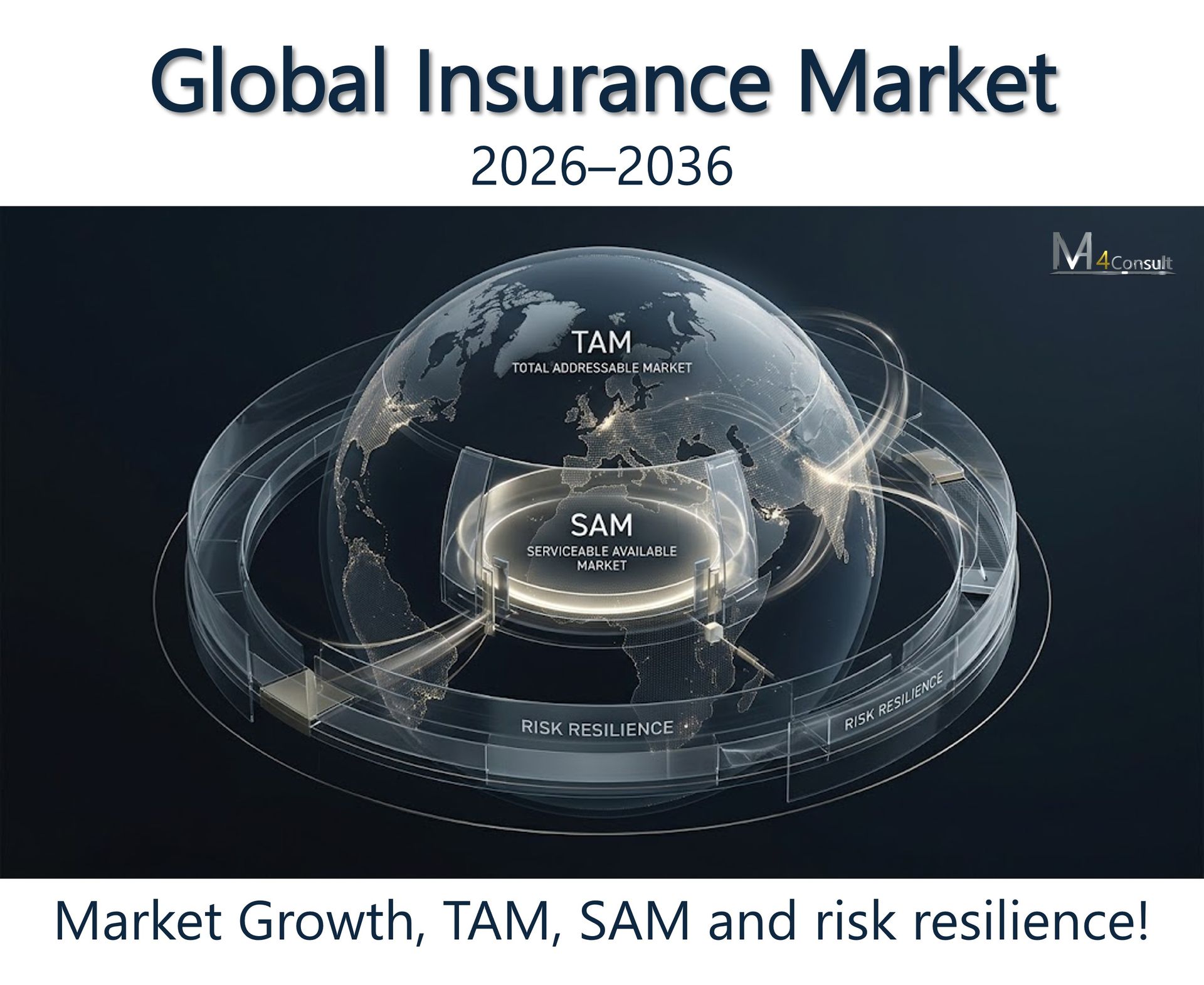
New MA-4Consult modelling across more than 150 national insurance markets shows that nominal market growth, real market development and commercially serviceable insurance opportunity can diverge materially — with particular relevance to strategic market assessment and the 2026 Baden-Baden renewal discussions.
Vienna, Austria -11 September 2026 - MA-4Consult has published its latest Global Insurance Market Sizing and Forecast 2026–2036, projecting a global Total Addressable Market (TAM) of $6.90 trillion in 2026 and $8.58 trillion by 2036. The analysis covers more than 150 national insurance markets and examines global market size, Life and Non-Life insurance, TAM and Serviceable Available Market (SAM), regional economic shifts, and economic, political, institutional and risk-related factors.
Its central conclusion is straightforward: Market Size ≠ Market Opportunity. The MA-4Consult model indicates that nominal insurance market expansion does not automatically translate into equivalent real premium growth or commercially accessible insurance business. For insurers, reinsurers, brokers and institutional capital providers, the strategic question is therefore not simply how large the global insurance market is, but how much of that market can realistically be addressed under prevailing economic, regulatory, institutional and risk conditions.
MA-4Consult's 2026–2036 global insurance market forecast projects $8.58 trillion of global TAM by 2036, while demonstrating that total market size does not equal commercially serviceable opportunity. By combining TAM/SAM analysis, Life/Non-Life market structure and the proprietary RRF-i resilience framework across 150+ national insurance markets, the analysis provides a forward-looking perspective for insurers, reinsurers, brokers, cedents, MGAs and institutional capital ahead of strategic market and renewal decisions.
Global Insurance Market Forecast 2026–2036: $6.90 Trillion to $8.58 Trillion
According to the MA-4Consult market model, global insurance TAM reaches $6.90 trillion in 2026, representing 3.8% year-over-year growth. Growth is projected to normalize to 2.5% in 2027, with global TAM reaching $8.58 trillion by 2036. The resulting nominal global TAM CAGR is approximately 2.2% over the 2026–2036 forecast period.
The analysis also distinguishes nominal market expansion from real premium growth. The modeled real CAGR is approximately 2.1% for Non-Life insurance and 1.9% for Life insurance. These figures are MA-4Consult model outputs and should not be interpreted as industry-wide consensus forecasts. This distinction is particularly relevant in a market environment affected by inflation, changing interest rates, fiscal pressures and evolving loss costs.
— M. Aigner, MA-4Consult:
„ The global insurance market is projected to grow nominally from $6.90 trillion to $8.58 trillion. That does not mean that real insurance market development or underlying economic growth will increase at the same rate. For renewal discussions, it is therefore essential to distinguish nominal premium growth from real market development and risk-bearing conditions.“
Global Insurance Market Remains Highly Concentrated
The MA-4Consult forecast indicates that global insurance market growth remains heavily concentrated among a relatively small number of national markets. The five largest insurance markets by projected 2036 TAM are:
- United States
- China
- United Kingdom
- Germany
- France
Together, these five markets represent approximately 65.7% of global TAM in 2036, while the ten largest markets account for approximately 77.0%. The United States remains by far the world's largest insurance market, with projected 2036 TAM of approximately $3.41 trillion. This comprises approximately $1.20 trillion of Life TAM and $2.21 trillion of Non-Life TAM, giving the United States an estimated 39.8% share of global TAM. China ranks second with projected 2036 TAM of approximately $1.10 trillion.
— M. Aigner, MA-4Consult:
„The concentration of global insurance market volume in a small number of major markets is strategically significant. But absolute market size does not tell investors or insurance executives how much business can actually be accessed under the relevant regulatory, institutional and economic conditions.“
What Is the Difference Between Insurance Market TAM and SAM?
TAM measures the total modeled insurance market volume, while SAM represents the portion considered serviceable under relevant market-access conditions. A central component of the MA-4Consult analysis is the distinction between Total Addressable Market (TAM) and Serviceable Available Market (SAM). TAM represents the total modeled insurance market volume across the covered Life and Non-Life markets, based on projected premium volume. SAM represents the portion of that market that MA-4Consult models as serviceable under relevant regulatory, institutional, economic and operational conditions. The model shows substantial differences between national insurance markets.
For 2036, MA-4Consult projects:
- United States: $3.23 trillion SAM, or 94.9% of TAM
- China: $732.5 billion SAM, or 66.6% of TAM
- United Kingdom: 74.2% SAM/TAM
- Germany: 71.0%
- France: 69.7%
- Japan: 65.2%
Several smaller developed insurance markets show particularly high SAM/TAM ratios, including:
- Ireland: 95.7%
- Luxembourg: 89.3%
- Singapore: 88.7%
- Switzerland: 87.0%
The strategic implication is clear: the largest insurance markets are not necessarily the most accessible markets.
— M. Aigner, MA-4Consult:
„The key question is not simply which country has the largest TAM. It is how much of that market can actually be converted into addressable insurance business. TAM and commercial accessibility are two different strategic dimensions.“
For insurers, reinsurers, brokers and institutional investors, this shifts market assessment away from a simple country ranking toward a multidimensional evaluation of TAM, SAM/TAM conversion, Life/Non-Life structure and risk resilience.
Asia Gains Economic Weight Through 2036
The global insurance outlook is also shaped by changing regional economic weight. In the MA-4Consult modelling framework, Asia's share of global GDP increases from 32% in 2026 to 36% in 2036. North America's share declines from 29% to 28%, while Europe's share declines from 26% to 24%. For insurers and reinsurers, these shifts matter because long-term economic development can influence insurable assets, corporate investment, insurance penetration and addressable insurance potential.
The regional outlook highlights:
- North America: continued high market size and institutional resilience
- Europe: a major insurance market with a declining share of global GDP
- Asia: rising economic weight and increasing long-term insurance relevance
- Latin America: potentially attractive growth opportunities subject to macroeconomic and market-access conditions
- Middle East: increasing strategic relevance subject to geopolitical, macroeconomic and market-access conditions
— M. Aigner, MA-4Consult:
„The projected increase in Asia's share of global GDP to 36% by 2036 reinforces the need to reassess regional capital allocation and SAM strategies. Economic weight alone is not sufficient; the question is how effectively economic growth translates into sustainable, addressable insurance demand.“
How Do Life and Non-Life Insurance Markets Differ?
Life and Non-Life insurance markets differ materially in market structure, growth dynamics and addressable opportunity. The largest global insurance markets are not structurally interchangeable. The MA-4Consult modelling shows significant differences between Life and Non-Life insurance market profiles.
In the United States, projected 2036 Non-Life TAM reaches approximately $2.21 trillion, compared with $1.20 trillion in Life. China has a more Life-oriented profile, with approximately $614.6 billion Life TAM compared with $484.6 billion Non-Life. Japan is also strongly Life-oriented, with approximately $215.2 billion Life TAM versus $108.6 billion Non-Life. By contrast, Germany, Canada and Australia have stronger Non-Life profiles:
- Germany: $145.0B Life / $212.3B Non-Life
- Canada: $55.6B Life / $135.2B Non-Life
- Australia: $32.6B Life / $74.4B Non-Life
These structural differences have implications for product strategy, distribution, claims infrastructure, capital requirements, underwriting and market-entry models. Life-oriented markets and Non-Life-oriented markets can therefore require different approaches to product strategy, distribution, underwriting, claims infrastructure, capital allocation and market entry.
— M. Aigner, MA-4Consult:
„The world's major insurance markets are not interchangeable. Market size does not describe the underlying business model or the addressable opportunity. International expansion therefore requires a combined view of market size, market structure, serviceability and risk resilience.“
Risk Resilience Factor for Insurance: 60.5% 2026 Baseline
To complement conventional market-size metrics, MA-4Consult applies its proprietary Risk Resilience Factor for Insurance (RRF-i). The model establishes a global RRF-i baseline of 60.5% for 2026. RRF-i is a proprietary comparative framework developed by MA-4Consult to assess economic, political and institutional resilience across international insurance markets. RRF-i is a proprietary MA-4Consult model and is not an official regulatory or industry-wide index.
The framework combines:
- 60% macroeconomic factors, including inflation, GDP development and fiscal pressures
- 40% political and institutional risk factors
The broader analysis also considers macroeconomic volatility, geopolitical risk, cyber risk, IT supply-chain risk, natural catastrophe exposure and other systemic loss risks. RRF-i is intended to complement market-size indicators such as TAM and premium volume with an additional risk and resilience perspective relevant to market selection, capital allocation, underwriting, risk management and international expansion.
RRF-i is a proprietary MA-4Consult model and is not an official regulatory or industry-wide index.
— M. Aigner, MA-4Consult:
„The 60.5% global RRF-i baseline for 2026 provides a model-based reference point for comparing market resilience. For underwriting and capital allocation, macroeconomic, geopolitical, cyber and infrastructure risks increasingly need to be considered alongside historical loss experience.“
Why the Global Insurance Market Forecast Matters for Baden-Baden 2026
Baden-Baden is a key forum for insurance and reinsurance professionals preparing for the January renewal and new-business cycle. The 2026 Reinsurance Symposium is scheduled for October 18 at the Kongresshaus Baden-Baden and is focused on “Reshaping of the Risk Transfer Chain,” including developments involving risk transfer, brokers and MGAs, alternative capital and emerging technology.
Against this backdrop, the MA-4Consult analysis focuses on a question extending beyond headline premium growth:
Which parts of the global insurance market are actually addressable and risk-bearing under current economic, political, institutional and regulatory conditions? For the 2026 renewal discussions, MA-4Consult argues that rate adequacy, real premium growth and risk resilience should be assessed together, rather than treating nominal premium increases or aggregate market growth as standalone indicators. The distinction is particularly relevant when market conditions are influenced by inflation, loss-cost development, geopolitical uncertainty and changing capital requirements. The strategic message is therefore: Market Size ≠ Market Opportunity.
Key Findings at a Glance
- 2026 global insurance TAM: $6.90 trillion
- 2026 growth: 3.8% YoY
- 2027 projected growth: 2.5%
- 2036 global insurance TAM: $8.58 trillion
- Nominal 2026–2036 CAGR: approximately 2.2%
- 2036 Non-Life TAM: $4.72 trillion
- 2036 Life TAM: $3.86 trillion
- Markets covered: 150+ nations
- 2036 Top-5 market concentration: approximately 65.7%
- 2026 RRF-i baseline: 60.5%
Media Resources
Global Insurance Market 2026–2036 — Executive Press Clipping & Strategic Market Intelligence Map: MA-4Consult provides an English-language Executive Press Clipping & Strategic Market Intelligence Map summarizing selected findings from the Global Insurance Market Sizing and Forecast 2026–2036. The resource covers global insurance market growth, TAM and SAM, market concentration, Life and Non-Life structure, risk resilience and strategic market opportunity across 150+ national insurance markets.
Download the Executive Press Clipping & Strategic Market Intelligence Map (PDF):
About the Report
- Publication: Global Insurance Market Sizing and Forecast 2026–2036
- Publisher: MA-4Consult
- Forecast period: 2026–2036
- ISBN-13: 979-8194887309
- Geographic scope: 150+ national insurance markets
- Language: English
The report provides an independent quantitative framework for evaluating global insurance market size, addressable opportunity and risk resilience. It combines insurance market data, quantitative market modelling, multi-source data triangulation, macroeconomic indicators and political and institutional risk factors to assess global Life and Non-Life insurance markets.
The analysis is intended for insurers, reinsurers, brokers, institutional investors, analysts, Chief Underwriting Officers, Chief Risk Officers, strategy teams and business decision-makers evaluating market entry, underwriting strategy, renewal decisions and capital allocation. The publication is designed as an independent research and intelligence product and is not issued on behalf of an insurance association, reinsurer, broker or regulatory authority.
The report is available in print on Amazon and in digital format via Google Play Books:
- Amazon: https://www.amazon.com/dp/B0HH776T2F
- Google Play Books: https://play.google.com/store/books/details?id=yFMHEgAAQBAJ
About MA-4Consult
MA-4Consult is an independent Austrian research and publication brand focused on strategic intelligence in complex B2B and B2G markets. Its Insurance Intelligence activities focus on global insurance market analysis, country-level risk intelligence, TAM/SAM market modelling and the proprietary Risk Resilience Factor for Insurance (RRF-i). MA-4Consult combines quantitative market modelling, multi-source data triangulation, OSINT and scenario-oriented analysis to support strategic assessment of international markets.
Vienna, Austria
Editorial and Methodological Note: All market values, forecasts and RRF-i figures presented in this release are MA-4Consult model outputs and analytical estimates. They represent forecasts rather than guarantees of future market development. The Baden-Baden event information and dates referenced in this release have been checked against current industry event sources. The Baden-Baden Reinsurance Meeting is scheduled for October 2026, with a Reinsurance Symposium taking place on October 18, 2026. MA-4Consult is an independent research and publication brand and is not presented as an official sponsor, partner, organizer, speaker or data provider of the Baden-Baden Reinsurance Meeting.
Landmark Intelligence Report Released Under the MA-4Consult Brand: Global Insurance Market Sizing and Forecast (2026 - 2036)
Insurance market intelligence brand MA-4Consult officially releases its latest benchmark report - NAVIGATING POLYCRISIS: Unlocking the $8.6 Trillion Global Insurance Market (Global Insurance Market Sizing and Forecast 2026-2036)-mapping short-term market pivots from a $6.9 Trillion horizon in 2026 to decadal growth across 150+ nations.
VIENNA, Austria - September, 2026
As global insurers navigate compounding macroeconomic shocks and shifting rate environments, this comprehensive study replaces legacy industry research with unbiased quantitative foresight, projecting total gross written premiums to reach $6.90 Trillion in 2026 (3.8% YoY growth) before scaling to $8.58 Trillion by 2036. Built specifically for C-suite executives, Chief Underwriting Officers, Chief Risk Officers, and institutional capital allocators, the complete report is now available worldwide via Amazon and Google Play Books:
- Amazon (paperback; ISBN: 979-8194887309): https://www.amazon.com/dp/B0HH776T2F
- Google Books (E-Book): https://play.google.com/store/books/details?id=yFMHEgAAQBAJ
EXECUTIVE SNAPSHOT: PRIMARY MARKET SIGNALS
- NEAR-TERM HORIZON (2026-2027): $6.90T total addressable market (TAM) in 2026, driven by Non-Life premiums (55% / $3.78T) and Life premiums (45% / $3.12T), before growth normalizes to 2.5% in 2027.
- LONG-TERM SIZING (2036): $8.58T projected total market size ($4.72T Non-Life / $3.86T Life).
- CORE SEGMENTS (2036 SHARE): Life Insurance (45%), Health & Accident (25%), Motor (12%), Property (9%), Liability (3%), Marine, Aviation & Transport (1%), Specialty/Others (5%).
- ANALYTICAL SCOPE: 150+ sovereign jurisdictions evaluated via the proprietary Business Risk Resilience Factor (RRF-i), combining 60% macroeconomic and 40% political/institutional risk parameters.
2026/2027 NEAR-TERM INFLECTION & 2036 DECADAL OUTLOOK
The modeling reveals a pivotal near-term pivot as macro inflation, premium rate adjustments, and structural shifts recalibrate global gross written premiums across both Life and Non-Life sectors:
- Immediate 2026 Market Pivot: Total Gross Addressable Market (TAM) reaches $6.90 Trillion in 2026, backed by a solid 3.8% annual growth rate. Non-Life dominates near-term premium volume at 55% ($3.78 Trillion), while Life accounts for 45% ($3.12 Trillion)
- 2027 Growth Recalibration: Market expansion normalizes to 2.5% in 2027, marking a critical transition period where insurers must balance disciplined underwriting against slowing nominal expansion.
- Decadal Horizon to 2036 ($8.58 Trillion): Global premiums will scale to $8.58 Trillion by 2036 ($4.72 Trillion Non-Life / $3.86 Trillion Life), stabilizing toward a mature long-term growth rate of 2.1%.
- 2036 Segment Breakdown: Life Insurance maintains 45% of total TAM, followed by Health & Accident (25%), Motor (12%), Property (9%), Liability (3%), Marine, Aviation & Transport (MAT) (1%), and Specialty/Others (5%).
REDEFINING INSURANCE INTELLIGENCE THROUGH PROPRIETARY QUANTITATIVE MODELING
Unlike legacy research produced by rating agencies, commercial brokers, or trade groups with commercial or lobbying biases, strategic intelligence published under the MA-4Consult brand is strictly independent.
More than traditional third-party analysis, reports under the MA-4Consult brand are powered by a proprietary quantitative modeling engine. Granular macro- and micro-economic indicators are systematically collected, structured, and integrated with deep insurance industry market data. By modeling customer CAPEX/OPEX structures, bottom-up market pricing, and top-down macroeconomic parameters, the MA-4Consult framework delivers unbiased, highly precise, and decision-grade predictive insights.
CORE STRATEGIC TAKEAWAYS & RISK FRAMEWORKS
- Serviceable Available Market (SAM) Quantification: Actionable SAM metrics are established at 76% of TAM for Life ($3.0 Trillion) and 81% of TAM for Non-Life ($3.8 Trillion), providing capital allocators with realistic targets for market entry and expansion.
- Proprietary Business Risk Resilience Factor (RRF-i): Evaluates 150+ sovereign states through a weighted index combining 60% macroeconomic parameters (inflation volatility, GDP trajectory, fiscal stress) and 40% political/institutional risk factors.
- Geopolitical & Systemic Risk Interconnections: Deep-dive analysis covering USD structural dependencies, sovereign debt shock fallout, cyber single points of failure (SPOF), parametric innovations, and Agentic AI deployment in underwriting.
STRATEGIC DISTRIBUTION ARCHITECTURE: SECURE, NEUTRAL, AND GLOBAL ACCESS
To ensure the highest standards of data security, seamless global logistics, and total operational discretion, all MA-4Consult professional publications and market reports are distributed exclusively via Amazon and Google Books. Prioritizing customer access through neutral, world-class marketplaces provides industry stakeholders with critical operational advantages:
- Maximum Security & Privacy: Organizations benefit from transparent transactions, corporate billing flexibility, and industry-leading data protection protocols provided by the world's most trusted platforms.
- Instant Global Availability: Readers enjoy rapid physical delivery via Amazon Prime for print editions, alongside immediate cross-device digital access through Kindle and Google Play Books.
- True Industry Neutrality: Utilizing independent distribution channels guarantees full client discretion. Insights published under the MA-4Consult brand remain uncompromised by industry-specific provider interests, ensuring conflict-free perspectives for executive planning.
CITATION & ENTITY SUMMARY:
- Publication Title: Global Insurance Market Sizing and Forecast - The Independent Standard for Data Triangulation and International Risk & Insurance Intelligence Across 150+ Nations (2026-2036)
- ISBN (Paperback): 979-8194887309
- GGKEY: RCL5JKX8WPA
- Near-Term Market Sizing: 2026 TAM: $6.90 Trillion (3.8% Growth) | 2027 Growth: 2.5%
- Long-Term Market Sizing (2036): $8.58 Trillion Total ($4.72T Non-Life / $3.86T Life)
- 2036 Product Share: Life (45%), Health & Accident (25%), Motor (12%), Property (9%), Liability (3%), MAT (1%), Others (5%)
- Methodology: Proprietary Quantitative Model (60% Macroeconomic + 40% Political/Institutional Risk parameters within the RRF-i Risk Resilience Factor for Insurance)
- Primary Jurisdictions Modeled: 150+ Sovereign Nations (Top markets: USA, China, UK, Germany, France, Japan)
Official Website & Full Publication Catalog: Explore additional risk intelligence reports under the MA-4Consult brand at https://www.ma-4consult.at/
Lead Like Champions – The Leadership Book That Unlocks Peak Performance and Turns Hard Work into Decisive Wins

From boardroom to playing field: ignite a champion mindset, drive career growth, and achieve sustainable team excellence. A groundbreaking new leadership guide, Lead Like Champions: Winning Leadership Strategies from Elite Sports, is now available in both paperback and Kindle editions on Amazon!
Vienna, December 2025
This modern resource delivers a results‑driven approach to leadership, teamwork, and performance management — helping professionals move beyond outdated management playbooks toward smarter, trust‑driven strategies inspired by elite sports.
A Smarter Approach to Leadership
Leaders and managers across industries face the same challenge: teams work hard yet still miss decisive wins. Endless meetings drain energy, motivation fades despite clear goals, and outdated leadership models fail to deliver sustainable success.
Lead Like Champions provides a comprehensive framework for modern leadership, showing how to apply proven strategies from world‑class athletes and teams to business success. Readers will learn how to balance long‑term strategy with rapid execution, ignite a champion mindset, and use analytics for smarter decisions.
Key Insights and Benefits – Readers will gain:
- Clear lessons on Strategy vs. Tactics from Formula 1, American Football, and global sports.
- Practical methods to ignite the Champion Mindset for career growth and resilience.
- Guidance on Intelligence & Analytics to make smarter, data‑driven business decisions.
- Proven techniques for Team Leadership & Motivation without micromanagement.
- Insights from Sports Psychology to maximize productivity without burnout.
- A Champion Error Culture that turns mistakes into innovation and sustainable growth.
Designed for Leaders, Entrepreneurs, and Team Players
The book is tailored for executives, entrepreneurs, managers, coaches, and professionals who want to unlock peak performance in both personal and professional life. Whether leading a corporate team, scaling a startup, or striving for personal excellence, readers will find actionable tools to achieve better outcomes.
Why Lead Like Champions Matters
By focusing on universal success principles rather than outdated management tactics, Lead Like Champions helps professionals build trust, improve team motivation, and deliver sustainable results. The book highlights how sports‑inspired leadership strategies, analytics, and psychology can be transformed into competitive advantages for careers and organizations alike.
Lead Like Champions: Winning Leadership Strategies from Elite Sports now available:
- Paperback: https://www.amazon.com/dp/B0G71M9WNM
- Kindle E‑Book: https://www.amazon.com/dp/B0G71HFNQY
New Book Empowers Procurement Professionals to Master Best Value Procurement and Outperform Lowest-Bidder Models
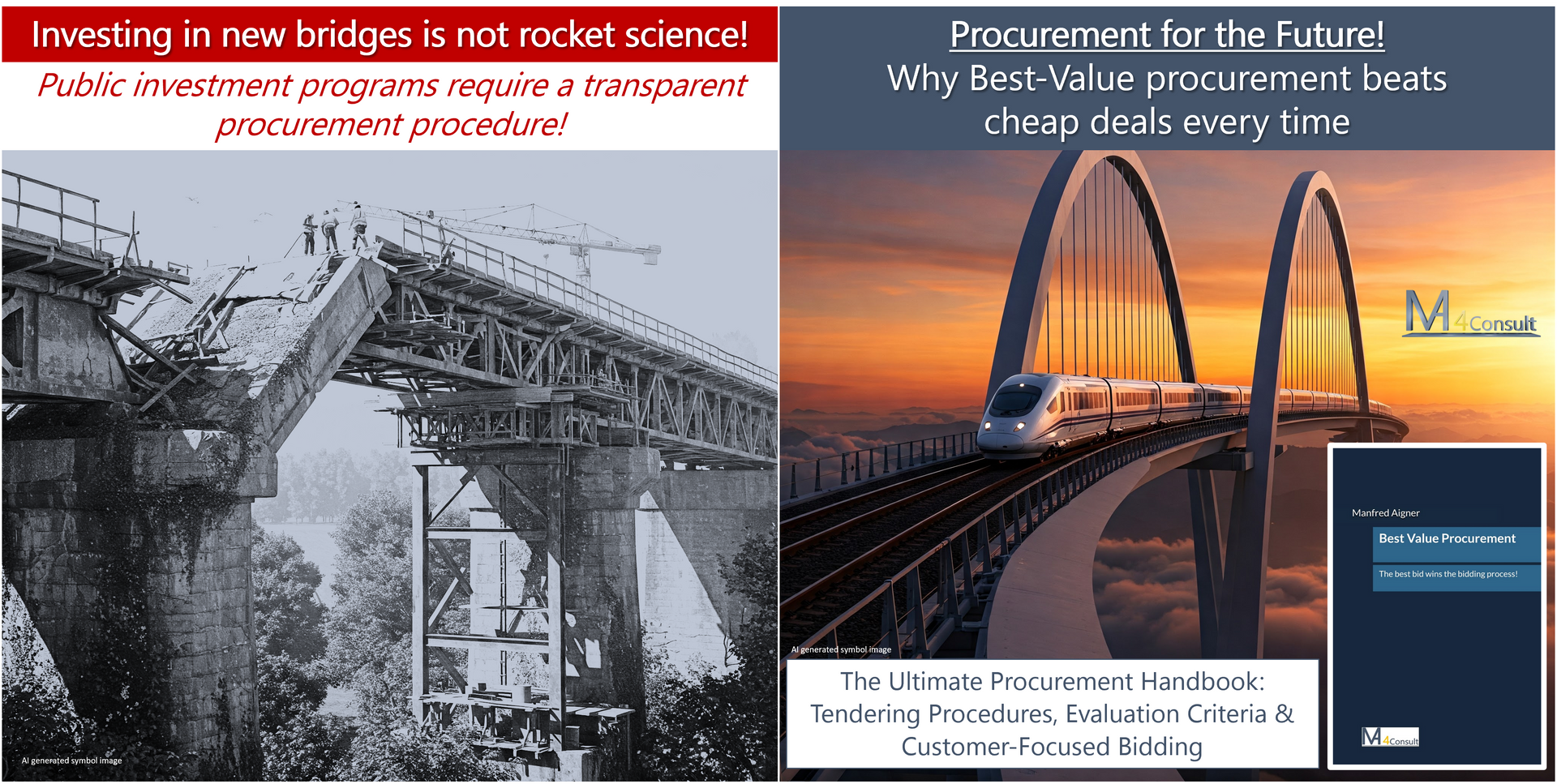
A groundbreaking new guide, Best Value Procurement: The Best Bid Wins the Bidding Process! is now available in both paperback (ISBN 979-8303877078) and Kindle (ASIN B0DQJRNTR7) editions on Amazon!
Vienna, November 2025
This professional resource delivers a modern, results-driven approach to procurement, tendering, and evaluation workflows - helping organizations move beyond outdated "lowest price wins" models toward smarter, value-based procurement strategies.
A Smarter Approach to Procurement
Procurement professionals across industries face the same challenge: balancing price vs. value. Too often, the lowest bidder wins contracts that later fail due to poor quality, sustainability gaps, or supplier risk. This book provides a comprehensive framework for Best Value Procurement (BVP), showing how to evaluate bids using criteria such as quality, lifecycle cost, sustainability, financial stability, and compliance.
Key Insights and Benefits - Readers will gain:
- Clear comparisons of Best Value vs. Lowest Bidder procurement models
- Step-by-step evaluation workflows for tenders, RFPs, and bidding processes
- Case studies of global procurement failures - from stalled wind farms to the Berlin BER Airport-offering lessons for risk management
- Actionable templates and checklists to streamline procurement processes
- Guidance on ESG alignment, supplier evaluation, and long-term value creation
Designed for Public and Private Sectors (B2B and B2G)
The book is tailored for procurement officers, project managers, government contractors, supply chain leaders, and business executives who want to improve transparency, accountability, and efficiency in procurement. Whether managing multimillion-dollar infrastructure projects or optimizing corporate sourcing, readers will find practical tools to achieve better outcomes.
Why Best Value Procurement Matters
By focusing on total lifecycle value rather than short-term savings, Best Value Procurement helps organizations reduce risk, improve supplier relationships, and deliver sustainable results. The book highlights how evaluation criteria, award workflows, and procurement compliance can be transformed into competitive advantages.
Best Value Procurement: The Best Bid Wins the Bidding Process! now available:
- Paperback: https://www.amazon.com/dp/B0DQPMZ1KT
- Kinde E-Book: https://www.amazon.com/dp/B0DQJRNTR7
Presse-Informationen und News veröffentlicht auf openPR (Deutsch 🇩🇪)
openPR Archiv (Benötigt Ihre Zustimmung zu allen Cookies):
Press Releases and News published on openPR (English 🇬🇧)
openPR Publications and NEWS (Please accept cookies to view):
Logo Download für Zitierungen und Referenzen | Logo download for citations and references

Die Marke "MA-4Consult" ist eine in Österreich unter der Marken-/Registernummer 317911 registrierte Wort-Bild-Marke, und darf daher nicht ohne vorheriger Zustimmung verwendet, kopiert oder in sonstiger Art und Weise verwendet werden. Weitere Details siehe Seite des österreichischen Patentamts unter Eingabe der oben angeführten Registernummer. Details finden Sie zusätzlich auf der Markendatenplattform des EU-Markenamtes.
The trademark "MA-4Consult" is a registered trademark in Austria under trademark/registration number 317911. This trademark includes both a word and a design, and its use, duplication, or other utilization is permitted only with prior consent. For further details, please refer to the Austrian Patent Office website and enter the above registration number. For more information, please refer to the EU Trade Mark Office's trade mark data platform.