
Sales Management, Leadership & Best Value Procurement Books
Hier klicken für die Version auf Deutsch (🇩🇪)

Drive sustainable growth in complex B2B and B2G markets by bridging the gap between potential and championship-level performance. In an era of market volatility, success requires more than just Efficient Sales (doing things right); it demands Effective Sales—the strategic ability to identify the correct customer pain points and prioritize high-impact opportunities. Our 2026 literature framework provides a roadmap to transition from outdated command-and-control models to Mission-Based Leadership, empowering teams to define the "how" while you master the "what" and "why".
Transform your organizational performance with evidence-based strategies:
- Mission Command: Eliminate micromanagement by fostering distributed trust and autonomous decision-making, ensuring your team maintains the speed of decisive action in chaotic environments.
- Best Value Procurement (BVP): Move beyond the lowest-bidder principle. Implement a Strategic Value Architecture that focuses on Total Cost of Ownership (TCO), technical innovation, and ESG goals to secure long-term project success.
- Lean Sales Excellence: Optimize your pipeline through systematic "De-goldplating"—stripping away unnecessary process features that add cost without customer value—to maintain a lean, agile sales operation.
- The Podium Mindset: Apply elite sports psychology and Pit-Stop efficiency from Formula 1 to business leadership, using competitive intelligence and real-time analytics to turn mistakes into innovation.
- Strategic GTM Execution: Master international Go-To-Market execution by applying the Ansoff Matrix and the 80:20 rule to prioritize the 20% of customers that drive 80% of your revenue.
Leadership, Executive Judgment & High-Performance Teams in the AI Era
Leadership in the age of AI and information overload means maintaining strategic direction, making sound decisions and leading teams through clear outcomes rather than micromanagement.
NEW:
Stop Being Busy, Make Your Time Count – Practical Rules for Effectiveness, Leadership & Decision-Making
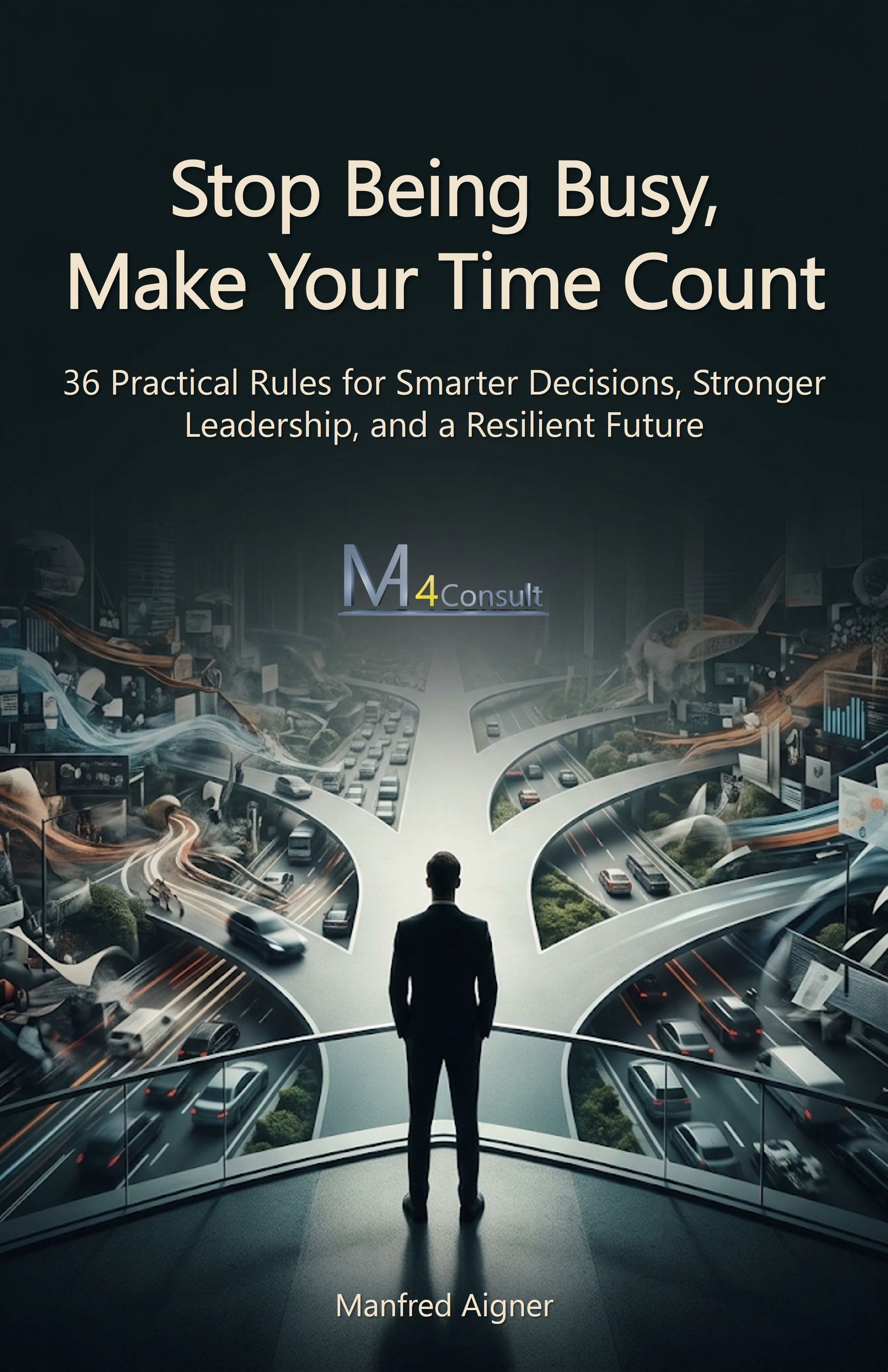
Discover 36 practical rules to stop being busy, make your time count, improve leadership, and build resilience.
Stop Being Busy – Make Your Time Count is a practical rulebook for professionals, leaders and entrepreneurs who want to make better decisions, protect their time and create meaningful results in an increasingly complex and AI-driven working world.
Does digital noise really make you more productive — or are you simply typing prompts faster while moving in the wrong direction?
As artificial intelligence can answer routine questions, generate content and process information within seconds, the source of professional value is changing. AI can provide data, analysis and content — but it does not take responsibility for the outcome and does not determine the right direction.
What matters increasingly is human judgment: knowing what matters, distinguishing relevant signals from digital noise, making decisions under uncertainty and taking responsibility for the consequences.
Many professionals and leaders find themselves caught in the busyness trap:
long working hours, countless digital tools, endless email chains, constant notifications and the feeling of being exhausted at the end of the day without having moved anything truly important forward.
You can automate the wrong objective perfectly — and still make no real progress.
Stop Being Busy – Make Your Time Count
is neither a theoretical textbook nor another superficial time-management guide. It is a practical rulebook
for effectiveness, decision-making, leadership, career development and personal resilience.
The book is designed to help readers turn constant activity into deliberate action, create more room for important decisions and build greater professional and personal freedom.
The book is available as a paperback (ISBN: 979-8176404258)
and Kindle eBook (ASIN: B0HKSZGXFS)
on Amazon.
The Five Pillars of Strategic Advantage:
- Judgment Over Information Overload
Learn to distinguish meaningful signals from digital noise. AI can provide information and analysis; human judgment determines what deserves attention and which direction to take. - Effectiveness Before Blind Automation
Automating the wrong task does not make it valuable. The objective is to turn information into clear decisions and meaningful action before applying technology at scale. - Leadership Through Freedom and Accountability
Build teams and systems that can operate without constant supervision. Clear objectives, delegated responsibility and mission command create decision-making freedom while maintaining strategic direction. - Resilience Before Crisis
Prepare while conditions are still favourable. Build career alternatives, professional independence, financial and mental reserves, and the capacity to respond when circumstances change. - Relationships Beyond Networking
Build trusted relationships before you need them. Sustainable professional value comes from credibility, cooperation and strategic alliances — not simply from collecting contacts or business cards.
Frequently Asked Questions About the Book:
What Makes Stop Being Busy – Make Your Time Count Different?
The book is written for professionals, executives, managers, entrepreneurs, project leaders, specialists and anyone who wants to become more effective without allowing constant activity to consume their time and attention. It is equally relevant to people who want to connect professional effectiveness with personal freedom, better decisions and long-term resilience. The central transition is simple: From being constantly busy to becoming deliberately effective.
What Makes This Book Different?
Instead of abstract productivity theory, Stop Being Busy – Make Your Time Count focuses on practical principles that can be applied immediately. The book addresses how to use
AI tools for routine work, create more time for important decisions, lead through clear outcomes, reduce unnecessary activity and build reliable professional relationships. The underlying approach is based on more than
25 years of practical business and leadership experience. The emphasis is not on motivational slogans or complicated productivity systems, but on
clear principles, sound judgment and actions that can be applied in everyday professional and personal life.
Lead Like Champions – Leadership Lessons from Elite Sports for High-Performance Teams

How do champions lead teams to perform under extreme pressure?
Lead Like Champions
explores how proven principles from Formula 1, football and American football can be transferred into modern business leadership. The book connects long-term strategy, flexible tactics and operational excellence into a practical framework for leadership and execution. It examines how leaders can overcome micromanagement through mission command, use competitive intelligence to understand competitors and markets, and use real-time feedback to develop agile, high-performance teams.
Rather than treating leadership as a collection of abstract management theories, the book looks at how successful teams operate when strategy, tactics, execution, communication and decision-making have to work together.
The book is designed for executives, business leaders and decision-makers who want to improve leadership performance and build resilient, high-performing organisations in dynamic markets.
Lead Like Champions
is available as a paperback (ISBN: 979-8278822158) and Kindle eBook (ASIN: B0G71HFNQY) on
Amazon.
TOP 10 Key Findings from "Lead Like Champions"
"Lead Like Champions" transfers practical performance mechanisms from elite sports into modern business leadership. Its central framework connects strategy, tactics and operational excellence to sustainable performance.
- The Three Levels of Performance
Strategy defines the direction, tactics determine how to move toward the objective, and operational excellence ensures reliable execution. - Mission Command
Clear objectives combined with decision-making freedom can replace rigid control mechanisms and create greater ownership within teams. Foster distributed trust across remote and hybrid global teams. - The Operational Negative Lever
Small operational failures can undermine even a strong long-term strategy. Execution therefore matters as much as strategic planning. - Real-Time Feedback
Immediate feedback in everyday work can address problems and improve performance faster than relying exclusively on formal annual reviews. - Systematic Competitive Intelligence
Consistent market and competitor analysis can strengthen decision-making, preparation and negotiation. - Defense Protects the Result
Winning new customers creates growth, while strong customer retention and after-sales execution protect long-term business performance. - Focus When Resources Are Limited
When resources are constrained, performance can improve by concentrating effort on specialised core capabilities and processes. - The Soccer-Street/Cage Mentality
High performance requires clear boundaries and expectations while giving team members meaningful decision-making authority within those boundaries. - Compact Communication
Clear, concise communication rules reduce misunderstandings at critical interfaces and improve execution. - Common Sense Before Metrics
Data and performance indicators are valuable, but customer understanding, practical judgment and common sense remain essential when making business decisions.
Who Is Lead Like Champions For?
The book is written for C-level executives, managers, entrepreneurs, project leaders, agile coaches, HR professionals and organisational development specialists who want to build and lead high-performance teams.
It is particularly relevant to leaders working in environments where strategy, execution, competitive intelligence, agility and fast decision-making determine organisational performance.
Together, the two books address two closely connected leadership challenges:
How do you decide what truly matters — and how do you build teams capable of turning those decisions into results?
White Paper: The Podium Mindset – Elite Sports Excellence for High-Performance Business Leadership

How can elite sports principles improve business leadership, strategic execution and high-performance teams?
- The Podium Mindset is a free MA-4Consult white paper translating lessons from Formula 1, football and elite sports into practical approaches to business leadership, competitive intelligence, strategic foresight, Mission Command and operational excellence.
High-Performance Leadership: What Business Can Learn from Elite Sports
- Elite sports combine intense competition, rapid decision-making, limited resources and high execution standards. The white paper shows how these principles can be applied to executive leadership, sales management, team performance and strategic execution.
Mission Command, Operational Excellence & Strategic Execution
- High-performing teams need clear strategic direction and effective execution. The Podium Mindset examines how Mission Command combines clear objectives with appropriate decision-making freedom, while operational excellence ensures that strategy is executed reliably.
Competitive Intelligence & Strategic Foresight
- The white paper connects competitive intelligence, market awareness and strategic foresight with leadership decision-making. The Battle Card methodology provides a practical framework for turning competitor and market intelligence into actionable preparation.
Formula 1, Football & High-Performance Teams
- Formula 1 demonstrates precision, preparation, coordination and operational speed, while football highlights strategy, tactics, specialised roles and real-time adaptation. These principles are translated into practical approaches to team leadership, accountability, tactical flexibility and execution under pressure.
Download the Free White Paper!
FAQ – Effective Leadership, Mission Command & Sales Excellence
Best Value Procurement, Tendering & Procurement Strategy
Value over lowest price: effective procurement, competitive tendering and compliance for public-sector (B2G) and private-sector (B2B) procurement. Sustainable procurement outcomes increasingly depend on quality-weighted evaluation, best price-quality ratio and the transition toward capability-based procurement.

Best Value Procurement: Selecting the Best Overall Tender
Best Value Procurement – The best bid wins the bidding process
is a practical guide for public-sector buyers, procurement professionals, purchasing teams and B2G sales organisations. Instead of focusing exclusively on the lowest upfront price, the book examines how price, quality, risk, life-cycle costs and supplier capability can be considered when evaluating complex tenders. Using practical case studies, including major infrastructure projects and international tenders, the book explores tender evaluation criteria, pre-qualification, quality weighting, financial bidder capacity and procurement risk.
For suppliers, it provides practical guidance on B2G sales, consultative selling, needs analysis and differentiating value propositions in competitive tendering. The book is available as a paperback (ISBN: 979-8303877078) and Kindle eBook (ASIN: B0DQJRNTR7) on
Amazon.
What Does Best Value Procurement Offer Buyers and Sales Teams?
The book shows public-sector buyers and procurement teams how to develop transparent, quality-oriented tender evaluations while managing procurement and supplier risks. For B2G and B2B sales teams, it provides practical approaches to consultative selling, needs analysis and value-based differentiation — helping suppliers compete on more than price alone.
TOP 10 Key Findings from "Best Value Procurement - The best bid wins the bidding process!"
- Lowest price can create higher total costs: Hidden costs, delays and quality problems can outweigh an attractive purchase price.
- Price and quality should be evaluated together: Best price-quality approaches allow buyers to consider both commercial and qualitative factors.
- Financial capacity matters: Supplier financial strength and delivery capability can reduce the risk of project failure.
- Major projects require robust procurement structures: Weak competition, unclear responsibilities and inadequate governance can increase execution risk.
- Abnormally low bids require scrutiny: Significant price deviations can trigger additional analysis of cost assumptions and deliverability.
- A USP must create customer value: A differentiating feature matters when it addresses a genuine customer need and creates measurable value.
- B2G sales requires early engagement: Understanding public-sector requirements, procurement processes and budget cycles is essential.
- Transparency supports procurement integrity: Clear, objective and non-discriminatory evaluation criteria strengthen the procurement process.
- Sustainability can form part of value-based procurement: Environmental, social and regional-value considerations may be incorporated where permitted by the applicable procurement framework.
- Pre-qualification can improve evaluation efficiency: Structured qualification processes can reduce administrative effort and focus evaluation on capable suppliers.
Procurement Strategy Beyond the Lowest Price
Effective procurement is not simply about obtaining the lowest initial price. Value for money, quality, supplier capability, life-cycle cost, transparency and delivery risk can all be relevant to achieving successful procurement outcomes.
The transition from traditional product purchasing toward Best Value Procurement and Capability Procurement provides procurement professionals and suppliers with a framework for addressing increasingly complex B2B and B2G requirements.
FAQ – Public Procurement, Best Value & Tender Evaluation
B2B & B2G Sales Management, Lean Sales & Sales Process Optimization
Sales performance does not come from maximum bureaucracy. It comes from removing process waste, simplifying sales operations and aligning the organisation around customer value. Modern B2B and B2G sales organisations need more than additional tools, reports and approval processes. They need clear priorities, customer-centric processes, appropriate governance and the freedom to act where decisions are made. The MA-4Consult approach connects Lean Sales, sales process optimization, customer-centricity, Mission Command, sales operations and strategic sales management to create more responsive and effective commercial organisations.
Sales Processes Without Unnecessary Complexity: Lean Sales & De-Goldplating

Radical Sales Process Optimization Through Trust, Lean Principles and Customer-Centric Leadership.
Trust-Driven Sales Management - Sales Without Micromanagement is a practical MA-4Consult guide for B2B and B2G sales leaders, executives, sales operations managers and process managers who want to simplify sales processes, reduce bureaucracy and improve execution.
Instead of adding layers of approvals, documentation and internal controls, the book focuses on
de-goldplating: identifying and removing process requirements that no longer create meaningful customer, commercial or risk-management value. The approach combines Lean Sales, customer-centricity, clear decision rights and trust-based leadership. Practical models such as the RACI matrix, decision thresholds and the “Customer as the Atomic Core” organisational model help organisations shorten decision paths, reduce micromanagement and give experienced sales professionals greater operational autonomy.
The result is a sales organisation designed around
customer value, faster decisions, clearer accountability and reliable execution
across complex B2B and B2G environments. The book is available as a paperback (ISBN: 979-8293622603) and Kindle eBook (ASIN: B0FJVWWNZN) on
Amazon.
Key Findings of this book:
- Streamlined Sales Execution & Process De-Goldplating
High-performing revenue organizations separate doing the right things (effectiveness) from doing them effortlessly (efficiency). Accumulating administrative forms, redundant audit trails, and multi-layered sign-offs creates process "goldplating" that slows sales velocity without reducing business risk. Sales Process De-Goldplating is the systematic removal of non-value-adding administrative forms, approval loops, and redundant controls from a sales workflow to reduce deal friction and shorten sales cycle length. - Mission Command & Empowered Sales Autonomy
Rooted in military strategy, Mission Command provides sales teams with clear strategic intent, desired outcomes, and operational boundaries while granting qualified professionals the freedom to determine how to win the deal. Requiring senior sales executives to seek permission for routine commercial terms destroys accountability and delays customer response times. Mission Command in Sales is a leadership paradigm where executives define high-level strategic objectives and risk boundaries, granting frontline account executives autonomous decision-making authority within those parameters. - Customer-Centric Cross-Functional Alignment
The "Customer as the Atomic Core" framework restructures support functions — including legal, finance, procurement, and technology — around customer outcomes rather than internal departmental metrics. True customer-centricity requires dismantling operational silos so that non-sales departments act as accelerators rather than bottlenecks. The Customer as the Atomic Core model is an organizational structure where non-revenue functions (Legal, IT, Procurement, Support) are designed to orbit, protect, and enable the customer-rep interaction rather than enforce departmental silos - Agile Governance & Decision Thresholds
Case-by-case manual sign-offs freeze commercial momentum. Replacing individualized sign-offs with pre-approved financial, legal, and operational thresholds allows routine deals to move instantly while preserving corporate governance for genuine high-risk exceptions. Sales Decision Thresholds are predefined commercial, legal, and risk boundaries (e.g., standard discount limits, contract term caps) that grant sales teams immediate deal-closing authorization without manual escalation. - Trust-Based Culture & Total Customer Experience
In complex B2B and B2G environments, customer trust is forged across every organizational touchpoint — from legal negotiations to implementation engineering. Sustaining autonomy across these touchpoints requires a learning culture where teams can take calculated operational risks without fear of retribution. Total B2B Customer Experience (CX) encompasses the collective brand trust built across every commercial, technical, legal, and post-sale touchpoint, sustained by an organizational culture of psychological safety and responsible autonomy.
Customer Focus – Effective Sales Management

Customer-Focused Sales Management addresses the challenges of complex
B2B sales, B2G sales, international business development and sales management in changing markets.
The book focuses on building sales organisations that can combine customer focus, strategic sales management, digital transformation, data-driven sales processes and scalable execution. For companies operating across international markets, effective go-to-market execution requires more than a generic sales model. Sales teams must understand customer requirements, stakeholder structures, procurement processes, competitive dynamics and the specific conditions of each market.
The book provides practical approaches for sales strategy, bid management, sales enablement, CRM, forecasting, pipeline management and complex project sales.
Customer-Focused Sales Management is available as a paperback (ISBN: 979-8307332917) and Kindle eBook (ASIN: B0DTB21HRC) on
Amazon.
How can successful go-to-market strategies be generated?
Successful go-to-market strategies for complex international markets need to connect market strategy, customer needs, sales execution and measurable commercial outcomes. For B2G sales, this also means understanding how public-sector buyers evaluate tenders, supplier capability, technical merit, pricing and overall value. Current public procurement frameworks in the UK, Canada and Australia all place significant emphasis on value, evaluation criteria and supplier capability, although the specific rules differ by jurisdiction.
The book provides a practical roadmap covering:
- Strategic Bid Management: Develop stronger responses to tenders and RFPs by connecting customer requirements with a clear value proposition, evidence and risk management.
- Sales Enablement & CRM Optimization: Improve sales execution, forecasting and pipeline management with practical tools and structured sales processes.
- AI in Sales: Identify opportunities to use artificial intelligence to automate repetitive activities, improve sales information and support faster decision-making.
- International Project Sales: Manage complex sales cycles, multiple stakeholders and changing market conditions across international B2B and B2G projects.
The objective is not simply to increase sales activity. It is to create a more predictable, customer-focused and scalable sales organisation.
What Does Customer-Centric Sales Management Mean?
Customer-centric sales management means organising sales activities around customer needs, business outcomes and long-term value, rather than around internal departmental structures or activity metrics alone.
In complex B2B and B2G markets, this requires sales teams to understand the customer's business problem, decision process, stakeholders, procurement requirements and definition of value.
The result is a sales approach that connects customer needs, solution design, value communication, bid strategy and commercial execution.